Showing posts with label education. Show all posts

Sunday, February 14, 2016

The Equivalence Post

About twenty years ago--maybe right around the time LIGO was finally getting funding, when the gravitational waves it just detected were still a couple dozen star systems away--my elementary school class did a living wax museum. We researched a historical figure, dressed up as our subject, and, when a "visitor" to the museum pressed a red dot on our hand, recited a first-person speech based on our research. Unrepentant early nerd that I was, I chose Albert Einstein.

I don't really remember anything about the contents of my monologue. I probably gave a brief biographical sketch, but likely left out the part where Einstein bribed his first wife into divorce with Nobel money he'd yet to receive. I probably talked about the theory of relativity and how it merged space and time, but likely didn't include anything about Riemannian geometry and metric tensors.

My knowledge of the scientist and his science was patchy, to be sure, but that didn't stop me from admiring him. Einstein is the model of the lone genius working tirelessly, using nothing more than the power of his mind to change the world. For a long time, I imagined he and I were equivalent. I imagined that I alone knew the secrets of the universe and that my solitude represented nothing more than the gap in intellect between myself and others.

Before the inevitable deconstruction of that paragraph, let's talk a bit about Einstein the genius. While E=mc2 is his most famous equation, it's not the equation that made him famous. Physicists will tell you that general relativity was his crowning achievement.

GR grew out of Einstein's attempt to extend his special theory of relativity to gravity. SR and electromagnetism fit together perfectly, but gravity did not behave. According to Newton, gravity acts instantaneously, and that didn't sit well with light speed being the ultimate limit. To reconcile gravity with relativity, Einstein looked at a subtle difference between the electrostatic force and the force of gravity.

When two charged particles are sitting next to each other, the electrostatic force that one feels is proportional to the product of their charges divided by the square of the distance between them--simple enough. When two masses are sitting next to each other, the gravitational force on one is proportional to the product of their masses divided by the square of the distance between them. The forces are nearly identical, just swapping charge for mass.

But when a particle feels a force, it follows Newton's second law and accelerates by an amount inversely proportional to its mass, which is what inertia is all about. This means the mass term from gravity and the mass term from inertia cancel out and bodies under the force of gravity experience the same acceleration regardless of their masses. We know this; it's just the idea that a hammer and a feather (ignoring air resistance) fall at the same rate.

Thank you, NASA.
This quirk of gravity gets called the equivalence principle, because it seems to show that "gravitating" mass and "inertial" mass are equivalent, even though there's no particular reason why they need to be.

As Einstein thought about this peculiarity of gravity, he was struck with what he called "the happiest thought" of his life. He postulated a modification to the equivalence principle, which is that being in a gravitational field is equivalent to be in an accelerated reference frame. What he meant was that gravity is not a real force but an effect we observe, so there's no difference between your car seat pushing up against you when you hit the gas and the Earth holding you down.

The link to the other equivalence principle is that, in free fall, any object falling with you moves at the same rate, and the same thing is true in an accelerated reference frame, because the acceleration you feel is a result of the frame (your car, a rocket) and not your mass.

This happiest thought led Einstein to the conclusion that being in free fall in a gravitational field is just as "natural" as being at rest. When you do feel a force (your car seat, the ground), that's just an object getting in the way of your natural path through spacetime. As usual for Einstein, his next step was to imagine what this meant for light.

Assuming his principle is true, weird things happen in gravity. Say you're in a rocket ship at rest in space. If a beam of light comes in one window, it will trace a straight line through the rocket ship and out another window. If you're moving at a constant speed, you observe the exact same thing, because special relativity says you can't tell the difference between different inertial frames.

If you're accelerating, the light will trace out a parabolic curve, because you're moving faster when the light leaves the rocket than when the light enters it. The equivalence principle says you can't tell the difference between gravity and acceleration, so the same thing should happen if you're in a gravitational field. Light passing near the Sun, for example, will curve.

Now it's all well and good to say this happens because of the equivalence principle, but that's not a mechanism. If there isn't a force causing the light to curve, what's doing it? Einstein says this is the wrong question to ask and that what looks like a force is just light taking the only path available.

Here's an imperfect analogy: imagine you're driving up a mountain, maneuvering through twisting switchbacks. If you veer one way, you fall off the mountain. If you veer the other way, you crash into the side of it. So you stick to one narrow path. To the GPS satellites monitoring the position of your phone (but not the mountain or the road), it looks as if your phone, you, and the car are being pushed around by some mysterious force, but in reality you are simply following the only path available.

Except you might think, well that works for light zooming around at 300,000 km/s, but what if there's nothing propelling me? Why am I following any path at all? And the answer is that we are all following a path constantly through spacetime. We're moving forward through time. But in the presence of a gravitational field, spacetime gets warped, and your straight path through it moves a little bit out of time and into space. The "speed" you had going through time gets converted into speed in space, which is why clocks slow down close to a black hole.

Figuring out the specifics of how mass could warp spacetime took Einstein about a decade, but he finally succeeded in 1915, giving the world general relativity. With it came a number of predictions, including the bending of starlight, the correct shape of Mercury's orbit, and the fact that accelerating masses will send out gravitational waves that stretch and shrink spacetime as they pass by. Finally detecting those waves reaffirmed Einstein's genius one more time a century after he first proposed them. And all of that came from Einstein tinkering around with the fact that all objects fall at the same speed.

I said earlier that I equated myself to Einstein, but the truth is I'm no Einstein. I'm a pretty smart guy, but not a genius, and certainly not one of the greatest scientific minds in history, capable of deducing fundamental and quantitative physical truths about the universe from simple thought experiments. What can I possibly hope to achieve compared to that?

But there is an equivalence between me and Einstein, because in reality he was no Einstein, either. It took him a decade to complete general relativity because, talented though he was at math, he was not a mathematician and had to learn an entirely foreign branch of it to make his theory work. He got help from a mathematician friend of his, Marcel Grossmann, who was familiar with Riemannian geometry. That branch of math was invented in the 19th century by a couple of guys, including Bernhard Riemann.

The idea of looking at space and time as a unified thing was partly inspired by Hermann Minkowski, who applied geometrical concepts to Einstein's special relativity. Before Einstein even got to special relativity, which was critical for getting to GR, he frequently discussed difficult subjects with a group of likeminded friends that maybe ironically called themselves the Olymipa Academy. And most of the pieces for SR were put in place by earlier physicists, such as Hendrik Lorentz and George FitzGerald.

Black holes were first theorized about by Karl Schwarzschild, who found one of the simplest solutions to Einstein's field equations while fighting in the trenches during WWI. Roy Kerr figured out how rotating black holes behave. And many others over the ensuing decades contributed to the theory.

As far as gravitational waves are concerned, Einstein himself waffled as far as whether they even existed. But even so, he originally showed only that they could exist and radiate away energy. Solving general relativity for the shape of gravitational waves emitted by two inspiraling, merging black holes took until the 90s. In fact, it was only accomplished with the help of supercomputers using numerical techniques.

And even ignoring the many contributions from theorists not named Einstein, his prediction about gravitational waves would have meant nothing if we did not have the means to detect them. The feat accomplished by LIGO this past week involved scientists who are experts in interferometry, optics, vacuum chambers, thermodynamics, seismology, statistics, etc. The effort required theorists, as well as experimentalists, engineers, and technicians.

I don't mean to imply that Einstein's work would be for naught without the janitors who cleaned his office, that he couldn't have done it without all the little people supporting him. I mean that Einstein's contribution to the discovery was only one part of a vast web of contributions by a host of extremely talented people, alive and dead, who did things Einstein couldn't have done.

On Thursday, we all learned the magnitude of what they had accomplished. Rumors of the discovery had been swirling around for awhile before it was announced. By the time I arrived at school on Thursday to watch the LIGO press conference, I had a pretty good idea of what they were going to say.

Yet that didn't detract from the occasion. Packed into a lounge in the physics department, students, TAs, professors, and I--maybe a hundred altogether--watched the press conference webcast on a giant screen. We all cheered when the discovery was confirmed and cheered again when we heard the primary paper had already been peer reviewed. Half an hour in, I had to leave to go to my theoretical astrophysics course. There, the professor and TA set up a projector and we all continued to watch the press conference. When the webcast ended, the professor took questions about gravitational waves.

Being a part of that, in the minutest and most indirect way, was thrilling. It was a day when Einstein's greatest theory was confirmed yet again, when a new field of astronomy began, and when a thousand scientists got to tell the whole world about the amazing thing they had discovered.

There's a certain--possibly strained--equivalence to my wax museum Einstein moment from 20 years earlier. School was involved, as well as a story about Einstein. But this time I was listening to that story. My passion for science and learning has remained constant, but the attitude has changed. Back then, and for a very long time after that, I took joy in knowing more than others, in being the smartest guy in the room.

Now I know that's not the case. But I also know it doesn't matter. We just don't learn about the universe by sitting alone and thinking brilliant thoughts. That is, at most, one part of the process. So I don’t have to be a mythical genius to contribute. I can be a part of something amazing, of humanity's quest to understand the world around us, just by collaborating with others who are as passionate as I am. I haven't done it yet, obviously, but just as Einstein's magnificent theory has been reaffirmed, so too has my drive to be a scientist.

Sunday, February 7, 2016

Who Cares What Old, Dead White Guys Thought?

The title of this post is inaccurate if you don't consider the ancient Greeks to have been white. But that's probably not a discussion I want to get into right now. Anyway, today we're discussing my ancient philosophy course from last semester, or more precisely, my Socrates, Plato, and Aristotle course.

There are two main points I'd like to articulate: (1) if philosophy has made objective advancements in the last 2,400 years, why should we care what philosophers thought 2,400 years ago, and (b) man, I had a really annoying classmate in my ancient philosophy class. In essence, I'm wondering whether it was worth it to take this class, just as I had similar concerns about the value of paper writing in my philosophy in literature class from last spring.

To think about the first point, there are two paths you can go down. First, you can go the "philosophy is the mother of science" route and wonder where that leaves philosophy nowadays. That is, there used to be essentially no distinction between being a philosopher and a scientist. Science is a relatively new word, and people like Newton were referred to as "natural philosophers." Science was just doing philosophy about nature rather than philosophy about justice or god or what have you.

The usual argument you see here is that philosophy birthed the sciences we're familiar with today, and where it's done so, philosophy is obsolete and the science is all that's left. There are still philosophers of physics today (after all, I took a class on that, too), but they're not doing physics. Philosophers of physics no longer ask whether the world is made of four fundamental elements, or if all matter is composed of atoms, or if the planets travel in perfect circles, because physicists have definitively answered those questions (no, depends, no).

So the domain of philosophy has shrunk. Where philosophy about the natural world is still relevant, it's in asking questions about physical models, rather than coming up with the models themselves. (Metaphysicists might disagree, but a lot of modern philosophers don't hold metaphysics in particularly high regard, as I understand it.) Similar shrinkage has occurred in the other sciences, with psychology being one of the latest disciplines to squeeze philosophy further.

Here I want to look at a particularly egregious example from my ancient philosophy course, Plato's tripartite soul. Plato reasoned that a statement and its contradiction cannot both be true at the same time. This is reasonable and one of the foundations of classical logic. Take a statement like, "The sun is yellow." Either that statement is true, or the statement, "The sun is not yellow" is true. They can't both be true, because one implies a contradiction of the other.

So then let's look to the soul. We've all had the experience of simultaneously wanting and not wanting the same thing. "I want to eat that chocolate cake" and "I don't want to eat that chocolate cake" are thoughts we can have at the same time. In the first instance, it's our carnal desire for the cake, but in the second instance, it's our willpower that's talking. But if the law of non-contradiction holds, it can't possibly be true that we can both want and not want a piece of chocolate cake simultaneously.

...unless we have a divided soul, as alluded to above. Plato identifies three different competing interests in the human psyche that can produce contradictory desires. Roughly, these are the appetitive, passionate, and rational parts of the soul. They are distinct and incompatible, Plato argues, otherwise the law of non-contradiction is contradicted.

And that's all well and good, and proceeds from some reasonable assumptions, but it's baloney as far as modern neuroscience and psychology are concerned. What a hundred years of research into the brain have taught is that the brain is really complicated, possibly the most complicated three pounds in the universe, and it's decidedly not true that you can chop it up into distinct, one-pound chunks.

(I've cleverly switched from talking about the soul to talking about the brain, but a distinction between the two was not necessarily important to Plato, and science says that "the mind is what the brain does.")

There are two main ways in which Plato's tripartite soul fails as a theory. The first is that there are probably many components to the human psyche, far more than three. The second is a subtle problem that has plagued philosophers for thousands of years, which is that it's possible for words and concepts such as "want" to have different meanings depending on the context. So you can want something, and you can want* something. The former may mean "desire enough to actively pursue," whereas the latter might be "like thinking about but have no inclination to pursue." In that case, you can not want something, and also want* it, and there is no contradiction.

This is a tricky problem that crops up all over the place, which is why analytic philosophers spend large chunks of their time trying to tease apart just what we mean when we talk about seemingly plain concepts such as free will or beauty or truth.

But if all we have to go on is what remains of a large, sometimes disjointed collection of Plato's writings, it's easy to find flaws in his logic. His work cannot defend itself. It's also possible that those old, dead white guys were just wrong about stuff. They had a limited amount of data and lacked the thousands of years of philosophical tradition (that they began) to draw upon.

Which brings me to my annoying classmate. During lecture, he frequently raised his hand and asked the instructor questions such as, "But doesn't that produce a contradiction?" and "But wouldn't that mean nothing is beautiful?" and "But didn't Plato condone slavery?" And every single time, the instructor would engage with him and answer his questions in a thoughtful manner.

Terrible, right? Provoking the instructor into discussing philosophy with us. Well, yes. We had two lecture periods and one discussion period per week, and he brought up his objections during the lecture period. His interruptions were so frequent that there was material we were never able to cover in class. And all of this was possible because, yes, duh, Socrates and Plato and Aristotle were wrong about stuff. It was very frustrating, but I suspect I'm coming off as kind of petulant here, so let's go back to Plato for a moment.

While Plato did divide the mind into three different parts, he had particular affection for one of those parts: the rational mind. It was through employing the rational mind in dialectic that truth could be revealed. This is where Plato's allegory of the cave comes in. Plato conceived of a metaphor where the reality we perceive is just shadow puppets lit by torchlight that we are forced to watch in some kinky Clockwork Orange setup.

Philosophers, however, have broken out of the cave and can see real objects illuminated by the pervasive, powerful sun. So there's a distinction between the ever-changing, distorted, and 2-dimensional shadows we think of as reality and the constant, colorful, 3-dimensional objects that actually compose reality. When we see a chair, we are only seeing an indistinct, imperfect shadow of a chair that does not fully encompass the essence of true chairness.

At first blush, this whole idea seems patently ridiculous. We all accept that our eyes can deceive us and that reality is maybe actually electrons and protons, but it seems laughable to suggest that in some eternal, unchanging realm there exists the true forms of the objects we behold here. Where is this realm? Is there a form of the electric fan there, the cell phone, the credit card offer?

Well, it's unclear how diverse Plato intended his realm of forms to be, but he almost certainly thought it was populated by mathematical objects. Many ancient Greeks (including Plato) took math and geometry as the model of a priori knowledge, knowledge we could come to know just by thinking logically and without relying on evidence from our senses. To Plato, this meant accessing Platonic forms.

So there's some ideal triangle out there, as well as a perfectly straight, infinitesimally thin line, and also the true form of the number 5. Again, this sounds plainly absurd. But let's look at a particular number, such as the ratio between the circumference and diameter of a circle: π.

In a little over a month, it will be Pi Day, which means the internet will be stuffed with memes about π pies and whether ϕ is the true constant and how π is a magical number that contains everything in the universe.

That last one relies on a conjectured property of π, that it is a normal number. A normal number is one that has an endless sequence of digits in a non-repeating pattern that are distributed perfectly randomly, with no particular numeral being more likely than any other. Assuming that’s true, then if you peer deep enough into the digits of π, you will eventually find your telephone number, or a bitmap of your face, or your life story written out in ASCII code.

But you'll also find a lot of nonsense, and there's no way to tell the true from the false, so this is more like Borges' Library of Babel than, say, the Encyclopedia Galactica. It’s true that highly random data has a lot of information in it, but there’s nothing profound about that; that’s numerology, not number theory.

Additionally, it turns out that almost all (real term) the real numbers are normal, but it's not easy to pick out any particular number and say that it's normal. Currently, there is no proof that π is normal, although the evidence suggests that it is.

But what if there is no proof? What if it turns out to be impossible to demonstrate rigorously that π is a normal number? (You can often prove that it's impossible to prove something in math, but maybe a proof is just never found.) In math, a statement is only taken to be true if can be proven via deductive logic. So if there is no proof that π is normal, is it normal?

Well you're probably thinking, it's either normal or not, duh. Its being normal doesn't depend on whether or not we're smart enough to prove it. The Earth was four and a half billion years old long before we were able to show, scientifically, that it was. But look what's happened here. We've asserted that π has definite properties independent of our conception of it. That is, we're saying π is real, as real as the Earth, and that it has a form beyond our crude and incomplete perceptions.

So perhaps Plato's forms are not as crazy as they sound. Now, I'm not arguing that Plato is correct and that numbers are "real." This is a lively debate in the philosophy of mathematics (a subject I'll have more to say about at the end of this semester), with the other positions being "idealist" and "anti-realist." But Plato originated (or was the best, earliest articulator of) one tradition in this philosophical debate.

Which brings me back to my annoying classmate. If instead of a philosophy course, this had been a course on the history of Ancient Greece, at no point during the lecture would a classmate have interrupted the instructor with, "But teacher, weren't the Athenians wrong to butcher and enslave whole cities?" Of course they were wrong! That is clearly not up for debate. What's interesting, however, is why the Greeks did what they did, and how their actions propagated through history. That is, I want to understand the legacy they left behind, the traditions they began.

And that's how I look at an ancient philosophy course. To me, it's not primarily about finding all the myriad logical inconsistencies in the thoughts of some old, dead white guys, but in understanding how their thinking shaped humanity for millennia to come. In some cases, their ideas are obsolete and need to be discarded, while in others they represent the seeds of debates still flourishing in philosophy now. The greatest difference I see is that philosophers today strive for precision and nuance so as to avoid falling into the same old traps. But we couldn't have gotten here, couldn't have learned that lesson, without first falling in.

Friday, September 4, 2015

Here's Where the Fun Begins

Hey guys. Remember me? Yeah, I haven't done any writing (fiction, blogging, or otherwise) in quite a while due to life being somewhat chaotic of late. I'd like that to change, so here's a quick blog post just to make sure I haven't forgotten how to type.

So I'm almost done with my first week of class, and I have now been to (or watched) at least one lecture for all of my classes. In the order in which I did so, here's a brief summary of said lectures followed by some general commentary. Man, this sounds exciting. I wish it were possible for Statcounter to track the exact paragraph in which my readers decide to leave the page.

Monday morning I had Quantum Physics I, which is an introductory course in quantum mechanics. Intro QM courses often seek to get students to develop some intuition for the quantum realm, which is quite counter-intuitive compared to the well known land of blocks sliding across incline planes. To develop this intuition, professors have students solve the Schrodinger equation again and again and again until their dreams are nothing but operators and wavefunctions.

To that end, the textbook we're using is Griffiths, which is apparently the text almost all intro QM classes use. Page one of that book writes down the Schrodinger equation and simply plows ahead from there. My professor thinks this is actually kind of a dumb way to go about things, so we're beginning the semester with the story of how quantum mechanics came to be.

Now, having been a science dude for quite some time, this is a story I've heard a lot. I'm getting some math to go along with it this time, but in general the story of quantum mechanics goes something like this:

Near the end of the 19th century, the kingdom of physics was at peace. Two centuries earlier, the father of physics, the great Sir Isaac Newton, had discovered the Stone of Counting, Calculus (this is a really funny joke), and used it to tame the very moon itself. Later, Maxwell forged together electricity and magnetism to bring light to the world. And Boltzmann conquered heat with entropy. Plus maybe some other things happened in the intervening two centuries.

But then evil blackbody radiation from the quantum realm brought about the ultraviolet catastrophe. Using classical thermodynamics, physicists predicted that hot objects would emit an infinite amount of energy at low wavelengths. Oh no! But then Planck saved the day by creating oscillators that only emitted and absorbed radiation in discrete chunks. Forced to obey a Boltzmann distribution, these oscillators were too few in number at low wavelengths to bring about divergent infinities.

Yet this was a false peace. Where did these quantized oscillators come from, and why did they only act in multiples of Planck's constant? Tune in next time to find out. (That's as far as we got in lecture. The rest of the story involves the photoelectric effect, emission lines, and some other stuff, but this post is already 8 paragraphs long and I'm only on my first class. Maybe I'll write a children's book about quantum mechanics.)

Tuesday morning (I have another class on Monday, but it's a discussion section and didn't meet the first week) I had Philosophy of Physics. This class is taught by a Distinguished University Professor who got a PhD in Mathematical Physics several centuries ago but then decided to go into philosophy for some reason. It turns out this class is mostly going to be talking about the "weirdness of quantum mechanics," which should make it a nice complement to that other class where I'm just going to "shut up and calculate."

Weirdness, though, is not about how maybe we're all really connected and you can change the world just by looking at it and other quantum woo like that. To this professor, the weirdness of quantum mechanics arises from an SAT-like analogy. Relativity is to space-time as quantum mechanics is to information. That is, Einstein taught us that space and time aren't what our intuition leads us to think they are, and QM does the same for information. Information, which has roots in probability theory, works differently than we think it does and the consequence is that quantum stuff can be correlated in ways that classical stuff can't. I think this is going to be pretty interesting.

Both my quantum classes were prefaced with a quote from Feynman about how nobody understands quantum mechanics. My QM professor thinks this isn't really true anymore and that the results of QM speak for themselves, whereas my philosophy professor thinks we might be getting close to an understanding via thinking about information theory.

Right after that I had Ancient Philosophy. I'm taking this class mostly because I need a history of philosophy credit for my philosophy minor, but also because I want to learn about some of the lesser known ancient Greek philosophers (Pre-Socratics, Stoics, Epicureans, etc.). And the text is chock full of readings from/about those philosophers. It was a shame, then, to learn that the instructor will mostly be teaching us about the moral philosophies of Plato and Aristotle. Yeah, that's good stuff. But doesn't everyone know that Plato's utopia is a dictatorial city-state run by wise philosopher kings? Sigh.

After a morning of philosophy came Observational Astronomy, which is the next required course in the astro sequence. This course is less about what's out there in the universe and more about how we come to learn about what's out there. We'll be studying optics, image processing, celestial coordinates, statistics of signal and noise, and how CCDs work. The biggest chunk of this class grade-wise is some observational projects where we have to take data from the observatory and process it into something useful and meaningful. That's pretty awesome.

Wednesday morning was another lecture of QM. Wednesday afternoon I had Solar System Astronomy. Like ancient philosophy, I'm taking this course mainly because I need a number of upper level astronomy courses to fulfill my major. I'm not super-interested in solar system stuff, but for some reason I'm trying to graduate next spring (it might have something to do with me turning 30 in a couple months...), which means I kind of have to take what's available. Also like Ancient Philosophy, I learned during the first class that this won't be a wide-ranging course about all aspects of the solar system, but will focus mostly on planetary geology, delving into the planets and other rocky bodies that inhabit our sun's domain.

After some thought, I realized I'm actually pretty okay with this. The one novel for which I have something approaching a rough draft spends a lot of time on Ceres and Europa, two big spheres about which I am not all that qualified to say much, despite the number of Wikipedia articles I've read. So, you know, getting a grounding in how these kinds of worlds really work might improve my ability to write about the things I'm already writing about. Or it just might make my infodumps that much more painful. We'll see. Either way, this course involves a term paper about some topic in solar system astronomy, so I'll definitely be writing.

Thursday was identical to Tuesday, and I'm writing this Friday morning, but Friday is essentially identical to Wednesday. The only class I haven't talked about is an online one, Theory of Knowledge. This is an intro philosophy course in epistemology. The course probably technically started Monday, but due some technical glitches (the course is being hosted on the professor's personal website, which he coded himself), I wasn't able to watch the first video lecture until Thursday evening.

During that video, the professor talked about the benefits of online courses, such as the freedom to edit lectures into conveniently sized chunks by excising parts that aren't helpful. Also during that video, the professor gave instructions on how to access his site in a video that his students could only be watching if they had successfully accessed his site.

Anyway, I'm pretty excited about this course. Epistemology is a fascinating subject to me as it acts as a bridge between thinking about the world and knowing about it. The basic stance of modern epistemology is that knowledge is "justified true beliefs." But how do we know if a belief is true? And how can we justify our beliefs? And what does it actually mean to believe something? Epistemology asks and attempts to answer all these questions, and it does so in surprisingly technical ways, invoking psychology, neuroscience, Bayesian statistics, and other pretty modern tools.

Week 9 of the course examines the philosophy of psychedelic transformations. (But it's a 15 week course, so I'm okay with a brief excursion into eye-rolling territory.)

And that about does it. This is going to be my busiest, toughest semester since I returned to school for real in 2012. I've got 19 credits of 300 and 400 level classes. Plus I'm working.

As far as general commentary, I have two things to say. The first is a pattern that may be a coincidence or may be indicative of what happens at this level. My observational astronomy, quantum physics, and epistemology classes are all prereqs for more advanced topics. And all of those professors are covering a lot of ground that is necessarily going to be somewhat outside of their precise areas of expertise.

On the other hand, my ancient philosophy, philosophy of physics, and solar system astronomy courses mostly stand on their own and don't lead explicitly to anything else. And my instructors in those classes have chosen to focus on a particular branch of each field that happens to coincide with their research interests. Coincidence? Probably not. But it does mean I may want to pay more attention to which teachers are teaching which classes when I decide to take free-standing, upper level courses.

My other comment is that most of my instructors (this semester and previously) talk pretty openly about pedagogy, which I think is a good sign. One of the stereotypes of college is the ancient professor who stares at the blackboard with chalk in hand, talking nonstop for the duration of the lecture and paying little heed to any students who might also be occupying the classroom. My college career thus far has been largely absent that phenomenon, and I suspect the apparently institutionalized focus on pedagogy is partly responsible for that. So yay.

Sunday, April 12, 2015

If the Sequence Fits...

Okay, we're doing an old-fashioned blog post today, wherein I recount one of my recently completed labs. The lab portion of this semester's classes comes from my astrophysics course. This might seem a little weird, because we don't all have telescopes at our lab benches.

Hello, Edwin Hubble.
Instead, we're given data that we must analyze via Matlab. Interestingly, this is probably a bit closer to what real astronomers do, because astronomy today is less peering through a telescope in the wee hours of the night and more writing code to make sense of numbers sent to you from an observatory in New Mexico or Chile or space.

Hello, Hubble Space Telescope.
I've decided to blog this particular lab because I think it has the most interesting plots, which might be just the kind of statement required to turn away what few readers I have left. Specifically, we're looking at Hertzsprung-Russell diagrams, which are a very peculiar kind of graph astronomers use to confuse laypeople. Here's what they look like according to wiki:

Thanks, Wikipedia.
So the x-axis represents temperature, and higher temperatures are to the left. On the y-axis we have luminosity, which increases as you go up. What makes these diagrams strange is that it's not immediately clear what they tell you. Are you looking at different classes of stars? The same star at different times in its life? Stars at different distances (and thus ages) spread out all over the place? The answer is yes.

If you simply point your telescope at the sky, find a bunch of stars, and plot them on an H-R diagram, the only thing you will know with any certainty is that they're not all the same star. To get useful information from this diagram, you have to be specific about what you're looking at.

For this lab, we were looking at open star clusters, which are groups of stars that all formed from the same giant molecular cloud (real term). If that's true, then you can assume that all of the stars in the cluster are roughly the same age and roughly the same distance away from you. If you plot a cluster on an H-R diagram, a particular feature suddenly pops out: that big diagonal line called the the main sequence.

From astrophysical theories, we know that stars on the main sequence are those that are burning hydrogen in their cores. This is what our star is doing; it's what most stars that we look at are doing. Eventually, as a star gets older, it burns through all of the available hydrogen in its core and moves off of the main sequence (top right-ish) and becomes a giant of some sort, and then much later stops fusing at all and becomes a stellar remnant like a white dwarf (bottom left-ish).

What the existence of something like the main sequence means is that if a star is burning hydrogen in its core, and it's at some particular temperature T, then it will also be at some particular luminosity L. One demands the other. There is a pretty concrete relationship--for a main sequence star--between its mass, temperature, luminosity, and lifetime. Bigger stars burn brighter and hotter, go through their fuel more quickly, and thus leave the main sequence sooner.

But as I said earlier, if you just point your telescope at a bunch of stars, it's hard to know what you're looking at. In fact, the only information you get from a telescope about a star is how bright it is, and brightness is a result of a star's intrinsic luminosity as well as its distance from you. The farther a way a star is, the dimmer it is. Because of that, you don't always know if you are looking at a bright star far away or a dim star close to you. So how are we able to figure out a star's luminosity and temperature?

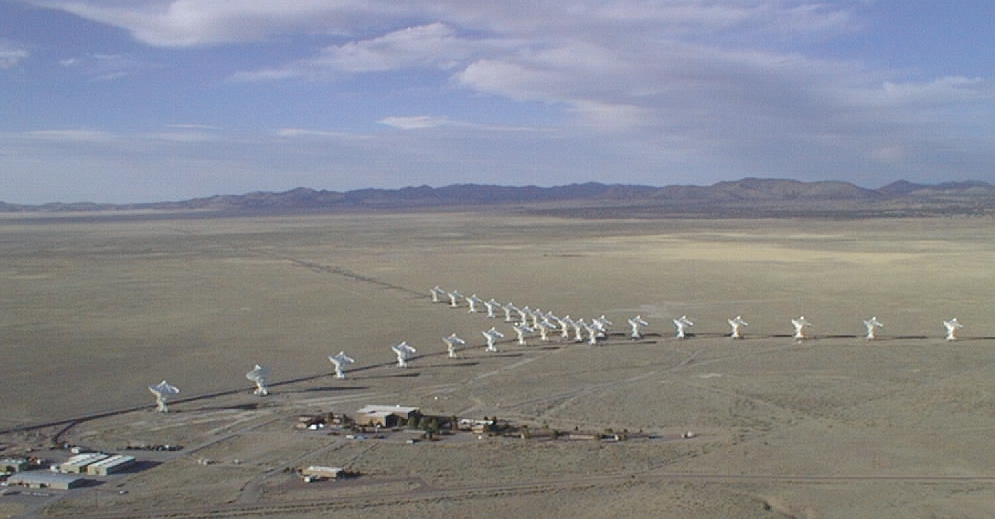
By restricting how we look at the star. Another difference between the popular image of astronomers and the reality is that the telescopes astronomers use today don't just indiscriminately collect all the light that hits them. In fact, some telescopes don't collect visible light at all. Some, like the Arecibo Observatory in Puerto Rico or the Very Large Array in Contact, for example, collect radio waves.

From APOD.
These telescopes look very different from visible light telescopes because light at different wavelengths has different properties that determine how that light moves. This necessitates different equipment. You know this just from looking at a prism. We all know a prism splits white light into a rainbow, but the reason it does this is because different wavelengths of light (different colors) bend at different angles depending on the medium they're moving through.

If this has an effect just between different colors of visible light, imagine the effect between visible light and radio waves and x-rays, for example. But at the visible light level, this discrepancy between how light behaves at different wavelengths means that you can collect more accurate information about an object if you look at it through filters that only pass specific ranges of wavelengths. This way you can calibrate your machinery just for those wavelengths and not worry about anything else.

There are a lot of filters astronomers use to look at stars. For this lab, we looked at stars through B and V filters, which eye-rollingly stand for blue and visible filters. It's enough to know that the B filter looks at bluer (shorter wavelength) light and the V filter looks at redder (longer wavelength) light. If a star is brighter in the B filter than the V filter, this corresponds to a hotter star. That's because stars roughly follow Wien's law, which says that a blackbody's peak wavelength--the wavelength at which it emits the most light--is inversely proportional to its temperature. So the more light at shorter wavelengths, the higher the temperature.

This observation lets us construct a particular H-R diagram called a Color-Magnitude diagram. For boring and annoying reasons (blame Hipparchus), astronomers measure the brightness of objects with the magnitude system, where smaller values represent brighter objects. For our CMD, the y-axis is the magnitude of light coming through the V filter (so higher on the graph is brighter, which means lower magnitudes). The x-axis, which is supposed to be temperature, is instead the quantity B-V.

Recall, if there's more blue light than red light, the star is hotter. More blue light means a lower B magnitude than V magnitude, which means hot stars will have a low B-V. Since temperature is plotted from hot to cold on the H-R diagram, this means we go from low B-V to high B-V on the x-axis.

So now we are plotting the B and V filter magnitudes of stars in the cluster M41, which we're assuming are all roughly the same age and distance from us. Here's the plot:


Hey, that looks kind of similar to wiki's H-R diagram! There's a clearly visible main sequence starting in the top left and moving down and to the right, and then there's a weird branch in the middle. Those are giants of some variety or another that have turned off of the main sequence. We can predict that this is a relatively young star cluster because it doesn't seem to have much in the way of stellar remnants (stars below the main sequence). What else can this CMD tell us?

For the purposes of the lab, we engaged in a process known as main sequence fitting that lets us figure out the age of and distance to a cluster.

As I mentioned earlier, brighter, hotter stars burn faster than dimmer, cooler stars; they leave the main sequence more quickly. So if all of the stars in a cluster form at roughly the same time, this means young clusters will have a pretty even spread of hot and cool stars, but old clusters will mostly have cool stars, because the hot stars will have stopped burning long ago. On an H-R diagram, this means that the main sequence of a cluster will slowly shrink over time, beginning with the stars in the top left. So where the main sequence ends, called the turn off point, corresponds to the youngest age a cluster could be. If it were any younger, then you would see hotter, shorter-lived stars farther up the main sequence.

This can be taken a step further. Through stellar evolution models (produced by computer simulations), you can plot the absolute magnitudes of various types of stars at a particular age. These models are called isochrones, because they show you a line of stars at a constant age. If you can match the features of your isochrone (such as the turn off point) to the features of your real cluster, you can date the cluster. In our lab, we had isochrones ranging from 100 million years old to 11 billion years old.

So let's date M41. First, let's compare it to the 11 billion year old isochrone (in red).


As you can see, this clearly doesn't fit. It's way farther to the right and way higher up than M41. But let's think about something for a moment. Being way farther to the right means it only has cold stars, which are old stars. We predicted above, because of the lack of stellar remnants, that M41 was probably young, so this makes sense.

By why is the isochrone so much brighter than M41? Here we can be fooled. We are seeing the cluster as bright as our telescopes see it, but the isochrone is a computer model which plots stars as bright as they would be if they were 10 parsecs (about 32.6 lightyears) away. Something seen at 10 pc is said to be seen at "absolute magnitude" for uninteresting historical reasons. If we were to adjust the magnitude of the isochrone, moving it up and down the y-axis, then we would also be adjusting the distance at which we saw it--the farther down the y-axis, the higher the magnitude, the dimmer the isochrone, the farther away it is.

We won't bother with that here, because this isochrone is obviously too old for our cluster. With some fiddling, we can find an isochrone that does fit. Specifically, the 300 million year isochrone.


This looks to have the right shape but is way too bright. So we know that our cluster is farther away than 10 pc. If we adjust the magnitude of our isochrone, we can get a better fit.


This isn't perfect, but the very nice alignment with the main sequence is encouraging. To get this match, we adjusted the magnitude of the isochrone by 9.2, which doesn't mean anything to anybody not steeped in dreadfully tedious astrometrics.

People steeped in dreadfully tedious astrometrics.
But here's the gist. Magnitude is a logarithmic scale, which in this case means that increasing the magnitude of an object by 5 decreases the brightness by a factor of 100. Because light gets dimmer with the square of your distance from it, an object 100 times dimmer is 10 times farther away. Doing the math, this means a 9.2 magnitude difference works out to the cluster being 69 times farther away than the isochrone, or 690 parsecs from us.

Looking up M41 on wiki (reliable?), it gives a distance of 710 parsecs and and age of 190 to 240 million years old. Not bad.

We then did the same thing for cluster M67. With many more stellar remnants (bottom-left), it looks like M67 is probably older.


After another round of main sequence fitting, this is our closest match.


An isochrone 3.5 billion years old with a distance modulus of 9.7, corresponding to 870 parsecs. Wiki says M67 is 3.2-5 billion years old and 800-900 parsecs away. Again, not bad. In fact, a better fit.

So that's main sequence fitting, one rung in the cosmic distance ladder (real term) astronomers use to show us how insignificant we are (by demonstrating the vast scale of the universe).

Wednesday, January 28, 2015

The Dark Ages Versus the Age of Discontent

Because I am somewhat of a "non-traditional student," my class schedule this semester would not immediately lead one to believe that I am an astronomy major. My classes are:

Astr 121 - Introductory Astrophysics II - Stars and Beyond

Phys 373 - Mathematical Methods for Physics II

Phil 233 - Philosophy in Literature

Phil 245 - Political and Social Philosophy I

Hist 111 - The Medieval World

You'll note the surprising dearth of astronomy courses. There are reasons for this, but detailing said reasons would make for a damn boring blog post, so I'm going to talk about something else (hopefully less boring) instead. (Worry not--the next two semesters will be as dense with astronomy courses as neutrons stars are with, uh, neutrons.)

Instead this post is about an interesting juxtaposition of beliefs I encountered in my fellow students. Both my medieval history and political philosophy instructors began class the first day by directly challenging the beliefs held by their students about a relevant subject (a surefire way not to convince the students of anything).

You can probably guess the common misconception in medieval history: the middle ages were a stagnant "dark age" where European savages meekly held onto life, all the while having any hint of progress quashed by the oppressive, aggressive ignorance of the Church.

So, that's false, of course. And I'm sure I'll learn a much more nuanced notion of what the medieval world was like during the next 13 weeks. But the idea that the middle ages were "dark" is a pretty commonly held belief, or at the very least the idea that people believe the middle ages were "dark" is a pretty commonly held belief.

My political philosophy instructor came at us from a different angle, however. He began the first lecture by presenting us with the idea that, compared to the societies in which the famous philosophers we're going to read about lived, we basically live in a utopia. Violence worldwide is lower than it's ever been at any time in history. GDP is leaps and bounds greater than it ever was in history. Yadda yadda.

This notion received a much cooler reception than the notion that the medieval period was not a dark age. I'll get to the difference between these two reactions in a moment, but the interesting point to me is that the default position to both ideas is one of disbelief. People do not believe the middle ages weren't hopelessly terrible; people do not believe now is (relatively) awesome.

At first blush, these two points of view would seem to contradict. How can we simultaneously believe that the medieval ages were terrible but that now is not terrible in comparison? We might believe that both periods were equally terrible, but that's not the general view held by my fellow students. To make the argument for the "dark ages," many pointed to the religious oppression that used to exist, but does no longer; to the authoritative regimes that used to rule, but do no longer; to the diseases that used to be so deadly, but are no longer. So they do not believe that each period is equally terrible.

Another possibility is that my fellow students have a nuanced position: that things used to suck really badly, but now suck only somewhat badly. But again, I don't believe this matches the professed opinions of my classmates. They were aggressively opposed to the notion that things don't suck now. They offered relatively little opposition to my history professor's arguments but jumped on everything my philosophy instructor said. Clearly, my fellow classmates feel very strongly that things aren't much better now. And that, I suspect, is the difference.

Daniel Kahneman and other psychologists have argued that when we are asked a difficult question, our brains take a shortcut by providing an answer to an easier question. We mentally change the question we are being asked to something that has a readily available answer.

So if the question we are asked is, "How good is civilization now compared to the way it used to be?", that's a relatively difficult question to answer. 7, maybe? A much easier question to answer, and one that is vaguely similar, is, "How do we feel about civilization now?" And we all have readily available opinions on the current state of things.

One of the reasons why the second question is easier to answer is because it doesn't ask us to evaluate the past. We haven't been to the ancient past; we don't know what it was really like. Unless we ourselves are historians, we're unlikely to have strong opinions about the past. And without strong opinions, we don't have easy access to "data" on what the past was like.

The other reason why the second question is easier to answer is because, of course, we have "data" about it. We don't necessarily have good statistics about what society today is like (although we might, and college students taking government classes and reading their preferred websites are likely to think they do), but we do have feelings about the present. I don't want to get particularly political here, but we're all inundated with news everyday telling us how terrible things are now, about racist cops, or the rape culture on college campuses, or the decaying moral fabric that holds America together, etc.

I have no desire to deny there are bad things now, that racism and sexism still exist, that our privacies are being eroded, that morally ambiguous wars are being waged, that much of the world still lives in abject poverty, or anything like that. Modern problems are real and worth dealing with, no doubt. What I'm getting at, however, is how those problems make us feel. They make us feel terrible, and we confuse that terrible feeling with what actually is.

Few of us feel terrible about the atrocities committed one hundred or one thousand years ago, however more terrible they may have been than atrocities committed now. You can argue, of course, that there's no reason to feel terrible about the past, because there's nothing we can do about it. We can change the world now, so our emotions do us some good in motivating that change. (The counter to this is something like the Holocaust Museum, which makes us feel absolutely awful on purpose so that we ensure nothing like it ever happens again.)

That's a valid argument, but it misses some nuance. Let's say that the world today is only half as bad as it was a hundred years ago, by some measure of Objective World Awesomeness (OWA). Do we think, then, that the feelings people had about the world a hundred years ago were twice as powerful as the feelings we have today? I sincerely doubt that. We feel to the maximum extent that we are capable about whatever we experience that we feel is deserving of the most emotion. Our feelings are characteristically not objective, essentially by definition.

The roundabout point I'm making here is that it is no surprise that we can believe the world today sucks while simultaneously believing that the world of the middle ages sucked, even if we don't believe they sucked equally or that today sucks only slightly less by comparison. The space for this seeming contradiction in our head comes from the fact that we evaluate world sucktitude by distinctly different measures--the present with emotions, the past with factoids. Our brains dispense with this cognitive dissonance by categorizing the past and present differently.

This isn't an unfounded hypothesis, and it's not untestable. To be sure, I suspect that the vast majority of students who come out of my medieval history class will do so saying, "Actually, it wasn't a dark age at all, because blah blah blah." But I suspect that while my fellow classmates may come away from the philosophy course knowing a good deal more about Locke, Hobbes, and Marx, few will leave it saying, "Actually, now doesn't suck quite so bad, because blah blah blah."

And I think this is a problem. I think we as humans too often substitute our feelings about a subject for objective evaluations of a subject. I say this from experience. To make this blog uncomfortably personal again, this is one of the big lessons I have learned in therapy: that the way I feel about something is not necessarily indicative of the way something actually is.

For a very long time, I believed I was incapable of change. This belief came from me having experienced superficially similar feelings for the last 10 or 15 years: loneliness, despair, self-hate, etc. And if my feelings were the same, that must mean I was the same, right? Well, no. I believed I could use my feelings about myself as an accurate measure of myself, but that belief was wrong (and kept me from combating my depression for a long time).

I suspect that most people fall prey to the same kinds of erroneous beliefs. (Most people don't go through a good chunk of their life depressed, though, and I suspect the difference there is that most people's erroneous, feeling-based beliefs aren't negative and inwardly focused.) And a good deal of psychological research backs me up on this. The beliefs we hold most strongly are not the ones backed up by the most evidence, but those associated with the strongest feelings.

What's the solution? Well, we could just make sure we brainwash people to believe the right things, but I don't think that tackles the central issue. I think a short-term solution is teaching people to be more critical of their own beliefs from a very early age, teaching people not to accept blindly what they feel to be true, perhaps even teaching people to actively distrust that which they feel most strongly about. The long-term solution is to modify human nature so that we no longer make this substitution error, but I have a feeling that's crazy.

Friday, November 22, 2013

“We won’t go into the details.”

I’m pretty sure I’ve talked a lot more about my math class than my physics class this semester. With the semester winding to a close, I don’t have much time life to even the score. But here’s an attempt. The reason for the relative silence on the subject of physics is, however, math-related.

As I mentioned in an earlier post, the third semester of intro physics is usually referred to as modern physics. At my community college, it’s “Waves, Optics, and Modern Physics.” The course covers a lot of disparate material. While the first half of the semester was pretty much all optics, the second half has been the modern physics component.

What does “modern physics” mean? Well, looking at the syllabus, it means a 7-week span in which we talked about relativity, quantum mechanics, atomic physics, and nuclear physics. All of these are entire fields unto themselves, but we spent no more than a week or two on each topic.

I predicted during the summer that I wouldn’t mind the abbreviated nature of the course, but that prediction turned out to be wrong. Here’s why.

The first two semesters of physics at my community college were, while not perfect by any stretch of the imagination, revelatory in comparison to the third semester. I enjoyed them a great deal because physical insight arose from mathematical foundations. With calculus, much of introductory physics becomes clear.

You can sit down and derive the equations of kinematics that govern how objects move in space. You can write integrals that tell you how charges behave next to particular surfaces. Rather than being told to plug and chug through a series of equations, you’re asked to use your knowledge of calculus to come up with ways to solve problems.

This is in stark contrast to what I remember of high school physics. There, we were given formulas plucked from textbooks and told to use them in a variety of word problems. Kinetic energy was 1/2mv2, because science. There was no physical insight to be gained, because there was no deeper understanding of the math behind the physics.

And so it is in modern physics as well. The mantra of my physics textbook has become, “We won’t go into the details.” Where before the textbook might say, “We leave the details as an exercise for the reader,” now there is no expectation that we could possibly comprehend the details. The math is “fairly complex,” we are told, but here are some formulas we can use in carefully circumscribed problems.

It happened during the optics unit, too. Light, when acting as a wave, reflects and refracts and diffracts. Why? Well, if you use a principle with no physical basis, you can derive some of the behaviors that light exhibits. But why would you use such a principle? Because you can derive some of the behaviors that light exhibits, of course.

But it’s much worse in modern physics. The foundation of quantum mechanics is the Schrödinger equation, which is a partial differential equation that treats particles as waves. Solutions to this equation are functions called Ψ (psi). What is Ψ? Well, it’s a function that, with some inputs, produces a complex number. Complex numbers have no physical meaning, however. For example, what would it mean to be the square root of negative one meters away from someone? Exactly.

So to get something useful out of Ψ, you have to square it. Doing so gives you the probability of finding a particle in some particular place or state. Why? Because you can’t be the square root of negative one meters away from someone, that’s why. The textbook draws a parallel between Ψ and the photon picture of diffraction, in which the square of something also represents a probability, but gives us no mathematical reason to believe this. Our professor didn’t even try and was in fact quite flippant about the hand-waving nature of the whole operation.

If you stick a particle (like an electron) inside of a box (like an atom), quantum mechanics and the Schrödinger equation tell you that the electron can only exist at specific energy levels. How do we find those energy levels? (This is the essence of atomic physics and chemistry, by the way.) Well, it involves “solving a transcendental equation by numerical approximation.” Great, let’s get started! “We won’t go into the details,” the textbook continues. Oh, I see.

Later, the textbook talks about quantum tunneling, the strange phenomenon by which particles on one side of a barrier can suddenly appear on the other side. How does this work? Well, it turns out the math is “fairly involved.” Oh, I see.

This kind of treatment goes on for much of the text.

Modern physics treats us as if we are high school students again. Explanations are either entirely absent or sketchy at best. Math is handed down on high in the form of equations to be used when needed. Insight is nowhere to be found.

Unfortunately, there might not be a great solution to this frustrating conundrum. While the basics of kinematics and electromagnetism can be understood with a couple semesters of calculus, modern physics seems to require a stronger mathematical foundation. But you can’t very well tell students to get back to the physics after a couple more years of math. That’s a surefire way to lose your students’ interest.

So we’re left with a primer course, where our appetites are whetted to the extent that our rudimentary tools allow. My interest in physics has not been stimulated, however. I’m no less interested than I was before, but what’s really on my mind is the math. More than the physics, I want to know the math behind it. No, I’m not saying I want to be a mathematician now. I’m just saying that I can’t be a physicist without being a little bit a mathematician.

Tuesday, October 8, 2013

The Wait

Due to fortuitous timing, my life is in somewhat of a holding pattern at the moment. There are three upcoming events that I can do nothing more than wait for. I will list them now in order of my increasing impotence to influence.

A week ago, I submitted a short story to a magazine. They say their average response time is five weeks, which means I have to wait another four weeks until they send me my rejection notice. With any luck, it will be a personal rejection.

This is the first story I’ve submitted for publication in several years. I think it’s probably the best thing I’ve ever written, and I know it’s decent enough to be published, but I shouldn’t fool myself into thinking that the first (or fifth, or tenth) publication I send it to will agree with me.

I was spurred into finally submitting a short story because a very good friend of mine just made her first sale. Unlike me, she’s been submitting non-stop for most of this year. Also unlike me, she’s been sending her stories to the myriad online magazines that have sprung up in recent years. I’ve sent my story, an 8,000-word behemoth, to the magazine for science fiction, because I have delusions of grandeur, apparently.

Moving on to the second item on my list, October is when I am supposed to hear back from the 4-year school I’m hoping to attend this coming spring. Their answer, unlike the magazine I’m submitting to, should be a positive one. Theoretically, I’m enrolled in a transfer program between my community college and the university that guarantees my admission so long as I keep my grades up and yada yada.

I’ve done all that, but I was still required to submit an application along with everyone else that wants to attend the school. And I’ve still been required to wait until now to receive word on my admission. All this waiting has me doubting how guaranteed my admission really is, but I’m still optimistic that the wait amounts to nothing more than a slow-moving bureaucracy. We’ll see.

Additionally, assuming I am admitted to the university, I then have to figure out how I’m paying for my schooling (community college is much cheaper) and how well my community college transcript transfers to my 4-year school. The hassle over figuring out what classes count as what could make for a whole other post. I haven’t decided yet whether I want to bore my three readers with the details.

And finally, as I hinted at in my last post, I’m a government contractor currently experiencing the joys of a government shutdown. So I’m waiting for our duly elected leaders to do their jobs and let me do my job. This is decidedly not a political blog, and I don’t want to get mired in partisan debates, but I have to say that I would much rather a system that doesn’t grind to a halt whenever opposing sides fail to reach an agreement.

There are a lot of theoretical alternatives to the system of representative democracy that we have, but I honestly don’t know enough about the subject to know which one would be better. Each system has pros and cons, and it is my limited understanding that no form of democracy is capable of perfectly representing the will of the people. If that’s the case, what hope is there for the future of civilization? Well, we can hope for an increasingly less imperfect future, I suppose. Or, to return to the SF side of things, we could just ask Hari Seldon to plan out the future for us.

The one political statement I’ll make here is that I never got over the wonder of Asimov’s psychohistory. I am a firm proponent of technocracy and the idea that, sometimes, it’s better to let experts make decisions about complex topics. Where I think democracy has its place is in ensuring that people are allowed to choose the type of society they want to live in. But if they really do want to live in society X, then they should let capable experts create society X first.

Okay, I think that’s enough pontificating for now. Is there some deeper connection between the three things I’m waiting for? Some thread that ties it all together? A concept from physics or mathematics that I can clumsily wield as an analogy? Nope. Sorry. Not this time.

Monday, September 30, 2013

On the Merits of Underwater Basket Weaving

I remember thinking awhile back that I wanted to post once a week. Well, here’s me trying for once a month. I really do intend to post more frequently, and if a certain political event comes to pass I just might have quite a bit of free time. We’ll see.
 

Anywho, today we’re going to talk about underwater basket weaving and its part in the End Times. There’s been a great deal of hubbub recently about education, about how it’s too expensive, or how our students are getting dumber by the minute, or how our universities are liberal brainwashing factories. You’ve heard it all. These are complex subjects without easy answers (which is kind of the point of this post), and I won’t presume to know what to do about them.
 

But there’s another talking point I’ve heard recently that I’d like to delve into a bit more deeply. You see, some people are taking the wrong classes. Not only that, but some people are majoring in the wrong subjects! Yes, that’s right, some people go to school for English, art history, philosophy, gender studies, or worse. What makes these the wrong subjects? Well, I’m a STEM major, and those are not STEM subjects, so clearly they are incorrect.
 

Wait, no, I’m sure there has to be more to it than that. Oh yes, it’s about money. Those other majors, you know, are a bit lacking in the career prospects department. You can’t major in underwater basket weaving and expect to have a six-figure underwater basket weaving job waiting for you on the other side of your diploma. Which is all well and good and none of my concern except that you’ve probably got five-figure student loans from the government that you’re not paying off, so you’re nothing but a parasitic leach on the meaty thighs of America.
 

And that brings us to the McNamara fallacy. This fallacy is best summed up in a quote about it from some guy named Daniel Yankelovich: 
The first step is to measure whatever can be easily measured. This is OK as far as it goes. The second step is to disregard that which can't be easily measured or to give it an arbitrary quantitative value. This is artificial and misleading. The third step is to presume that what can't be measured easily really isn't important. This is blindness. The fourth step is to say that what can't be easily measured really doesn't exist. This is suicide.
Now, you can look on Wikipedia, see that this is poorly sourced, wonder whether it’s really a fallacy, and point out that this fallacy is used by purveyors of pseudoscience to avoid having to prove their claims, but I want you to stick with me anyway. The gist of the argument is that it’s unwise to believe that easily measured variables are more important than not so easily measured variables. Historically, this is definitively true.
 

Historically, it was far easier to measure the sun’s apparent motion around the Earth than to measure the changing phases of Venus. The result: people believed the Earth was the center of the universe.
 

Historically, it was far easier to measure an object’s apparently natural deceleration than to measure the effects of friction. The result: people erroneously believed Aristotelian physics until Galileo and Newton came along.
 

There are plenty of other examples throughout history where insufficient means of observation led to incorrect conclusions. We cannot fault our ancestors for not having the tools we have, but we can fault ourselves for not heeding this lesson.
 

What am I getting at here? Well, it’s relatively easy to measure the economic potential of a particular educational choice. We can say with a fair degree of certainty that a mechanical engineer or computer scientist is very often going to make a good deal more money than a historian or poet. And by making more money, said individual will be a positive return on the investment that is the college loan.
 

Is that important? Probably. Wealthier nations tend to have greater scientific progress, less poverty, more freedom, etc. There are definitely some strong correlations between wealth and general awesomeness. But if all we measure is economic output, then we’re falling prey to the McNamara fallacy. What other measurements could we be performing?
 

I’m clearly not the only person to question the singular importance of STEM. Proponents of the humanities and liberal arts have written a great deal about the value of a less mathy education. A liberal arts education teaches you to be a better citizen, to be moral, to ask big questions, etc. And that all sounds good, but to a STEM major like me, it also sounds thoroughly unquantifiable.
 

There are two issues here. The first is that there may be hard to measure variables more strongly correlated with being awesome than economic output is. The second is that our definition of awesome may be based on our measure of economic productivity, leading us to miss other ways of being.
 

If the former is true, then we need to figure out ways to measure the value of an education in the humanities. Rather than simply studying philosophy or literature or art, we need to study the effects these subjects have on the brain, both neurologically and psychologically. One of the mantras of the humanities is that truth is discovered within the human mind. Well, I don’t presume to know what truth is, but I do know that science has made more discoveries than any other human endeavor ever has, so perhaps it can find the mind’s hidden truths.
 

If the latter case is true, and what we think of as the good life and success are not the end all be all (this and the former issue are not mutually exclusive, by the way), then it’s a bit harder to say what comes next. I have my own ideas, personally. I have an entire philosophical framework that underlies what I believe is important and meaningful, but there’s no particular reason why anyone should subscribe to my crazy ideas.
 

I can say this, however. We’ve been doing roughly the same thing for several thousand years now. Your average schmuck struggles to get by, to raise a family and live a fulfilling life, while toiling away at whatever job is required. But maybe that’s not the only way things can be. How else might we live a life? Well, let’s figure that out. Let's experiment and gather data. Instead of just studying philosophy, instead of reading about it in books and discussing what others have said, let’s do philosophy. Let’s make understanding life, morality, and knowledge central parts of being a citizen, and then we can see what sort of lives we end up living.

Friday, June 14, 2013

The Community College Syllabus


This is a pet peeve of mine and nothing more, but I've seen it a lot in similar contexts. Logging in "at least three to five times a week" makes no sense. We can log in at least 3 times a week. If we happen to log in 5 times a week, then that would still be at least 3 times a week.

You could argue that "at least" only applies to the three, but then he's telling us to log in a minimum of 3 times and a maximum of 5 times per week. Who knows, maybe's that the case. Given how often the website goes down, maybe they're trying to limit bandwidth usage.

Or he could be telling us that we must log in a minimum of 3 times per week, but he'd like to see us logging in between 3 and 5 times per week. Clearly, this is what is actually meant, but it is not what is written. Now, I know that no one is going to be confused by this. So it is what's conveyed, even if it is not what's written. So why am I complaining?

My reasons are three. First, he's an English teacher. He's going to be correcting our grammar for the next five weeks with varying degrees of exactitude, so it'd be nice if he showed the same amount of care in his own writing.

Second, this is a course designed for writing in the workplace. Like, if you wanted to be a tech writer, you might start with a course such as this one. Well, I've been a technical writer before. And you know what? Imprecise language like the phrase used above is not cool. It leads to mistakes, complaints, and lawsuits.


(Source)

Third, as a professor of English, he should really care about doing right by the language. Yes, language changes. Yes, the point of a language is communication, and if that's achieved, who cares about anything else.

But here's what gets to me. The English language is a gigantic hodgepodge of words and there are an absolute crap-ton of ways to arrange them meaningfully. So we can communicate precisely if we have sufficient mastery over syntax and vocabulary, but we don't because it's hard. Instead we think whatever we're thinking, vomit out the words we most closely associate with said thoughts, and hope the listener has roughly the same associations for those words, thereby getting the gist of the message across. Blech.

Thursday, June 6, 2013

State of the Student

Somehow now that I’m not leaving the house at 7:30 every morning and getting home at 10 every night I feel less inclined to blog. Odd, that. I don’t really have much to write about at the moment, but it’s been two weeks since I’ve posted and I don’t want to chance losing my legions of fans.

So, the semester is over and I’ve successfully completed a full year of schooling for the first time in 10 years. I should probably be more embarrassed about admitting that. Maybe now is a good time to take stock of things.

This time last year I had a cumulative GPA at my community college of 0.5, which was mostly a result of making some very poor choices in the early part of my college “career.” I wasn’t taking and failing classes; I was taking and not showing up to classes. But the end result was the same. Now, after having retaken all but one of my failed courses and taking a whole slew of new ones, my GPA is a 3.38.

Here’s a chart, so that I stay in character:


I’ve calculated that by the time I have my degree, I should have a GPA of 5.51. We’ll see how that works out.

What do I have left to do in community college? There are four more classes I need to take, and then I’ll be off to the big, scary 4-year university. This summer I start off by retaking another English course on writing for business and technology. That might be marginally useful for my future career, but I’m not betting on it being interesting. I consider having to retake classes like these my penance.

Later in the summer there will be a 5-week, whirlwind tour of linear algebra--the study of matrices. I understand that linear algebra is very important in computer graphics and a version of quantum mechanics. I’m not looking forward to learning it all in 5 weeks, but it’s what my schedule demands.

In the fall I’ll be taking differential equations and physics 3. DiffEq, as the cool kids call it, is at the heart of all physics. While calculus by itself is useful in that it allows you to make quantitative statements about change, differential equations are vital when those changes are recursive.

Way back in my second post, I mentioned that modeling air resistance is hard because it involves differential equations. The reason it’s hard is because of this recursive idea. How hard the air pushes on you depends on how fast you’re moving, and how fast you’re moving depends on how hard the air pushes against you. This would seem to be an infinite loop, but differential equations let you quantify that recursive relationship.

Then there’s physics 3, which is called Waves, Optics, and Modern Physics. The third semester of the introductory physics sequence typically gets a bad rap. And I don’t mean at my college, but all across physics departments. The usual complaint is that it tries to jam a whole bunch of not terribly related phenomena into one semester before the students really have the mathematical tools necessary to do these topics justice. Modern physics usually encompasses physics that is a mere century old--relativity, quantum mechanics, nuclear physics, and solid-state physics. There’s a lot to be said about all of these topics, and a good case can be made for there not being anything you can say about them in 2-week chunks.

I suspect I won’t mind much. What I’ve discovered so far is that most of my classmates come into the semester having virtually no background knowledge of the relevant material. Because I’ve been reading about science and math for so long, there was almost nothing I encountered this year that was entirely new to me. That’s not to say that I knew how to do the science--just that the concepts weren’t unfamiliar. I suspect the same will be true of modern physics, and I look forward to gaining more than just a surface-level understanding of these topics, even if it’s just below the surface.

And what comes after that? Well, the goal is that by spring 2014, I’ll be transferring to my state university where I will be approximately a junior. So 2 or 3 years from now I should have a bachelor’s degree in physics. I suspect I may get a double major in physics and astronomy because there’s a great deal of overlap between the two majors and astronomy is what I ultimately want to end up doing.

After that, the usual destination is grad school. At this point, that’s so far in the future that I haven’t given it much thought. I’ve heard repeatedly from academic bloggers that you should only go into grad school if you’re absolutely sure you want to go into academia. I can’t say that I’m absolutely sure right now, but we’ll see where I stand in a couple years.