Showing posts with label philosophy. Show all posts

Saturday, April 14, 2018

A World of Pure Imagination

In the philosophy of mathematics—hold on, hold on, I promise this is good—there's a perennial debate about whether numbers are real or just something we made up. This argument elicits a kind of irritated shrug from most people, but there is a fairly reliable way to evoke some pushback and/or incredulity: assert that imaginary numbers exist.

An imaginary number is the square root of a negative number, which of course doesn't make sense; any number multiplied by itself comes out positive. But mathematics is all about laying down axioms and seeing what logically follows. We can just declare that √-1 = i instead of a calculator error.

Alright, you think, but we can't just declare things into existence. What does an imaginary number even mean in the real world? You can have 3 apples, or maybe even -3 apples if you owe someone, but 3i apples has no concrete, physical interpretation, right?

Well, it turns out that by allowing complex numbers—a set that includes both real and imaginary numbers—we open up a new space for doing mathematics and physics. In fact, if we want to explain the bewildering diversity of chemical elements or the solidity of matter, we have to explore this imaginary space. Could anything be more concrete?

Take a look and you'll see...

Before we delve into the physics, let's make sure we have a little intuition about complex numbers. The imaginary unit, i, is the square root of -1. Just based on that, we see imaginary numbers cycle:

i*i = -1, because that's our definition

(i*i)*i = -1*i = -i

(i*i)*(i*i) = -1*-1 = 1

And (i*i*i*i)*i = 1*i = i again

This cycle lends itself to a neat geometric interpretation. Instead of the humdrum xy-plane, we can imagine a complex plane like this:

By Svjo [CC BY-SA 4.0], from Wikimedia Commons
Here, the horizontal axis is real and the vertical axis imaginary. Complex numbers are pairs that have the form a + bi, representing coordinates (or a vector) on our plane. If we draw a circle counter-clockwise through the points 1, i, -1, and -i, you see they follow the same cycle as our imaginary multiplication. So you can rotate through the complex plane just by multiplying two vectors.

It might look like we've only renamed a plain plane, but this space gives us flexibility the real numbers lack. Real numbers sometimes fall down on the job when you’re trying to solve polynomial equations. But if you say i is a root of -1, you can always find a complex number that does the trick. Geometrically, this lets us access points on the complex plane through simple multiplication, without having to rely on more cumbersome machinery.

Okay, finding polynomial roots probably sounds pretty boring, so we're not going to dwell on that. We'll mostly think in terms of complex rotation and how that permits us to peak into weird, non-Euclidean spaces where up and down no longer work the way they should. But know that in the background, these imaginary roots are letting us do a bunch of linear algebra by providing solutions to otherwise unsolvable equations.

We'll begin with a spin...

Let's turn back to physics. Explaining how the properties of chemical elements—the gregariousness of carbon, the aloofness of neon—arise from quantum mechanics goes like this: the protons and neutrons of an atom are squeezed into a tiny nucleus while the electrons whizz by in concentric orbital shells. How “filled” the outermost shell is (mostly) determines the chemical properties of an element. So whatever keeps these negative nancies from clumping together is responsible for, well, basically all macroscopic structure.

The culprit is the Pauli exclusion principle, which says that particles with half-integer spin (electrons) cannot occupy the same quantum state. Spin is intrinsic angular momentum, measured in units of ħ. If you measure the spin of an electron along some axis, you get either +1/2 (referred to as spin up) or -1/2 (upside down—spin down), with no other possible outcomes.

To keep track of the spin state of an electron, we can write a wave function that looks like this:

|↑⟩

Flip the electron upside down and the spin state is:

|↓⟩

Then flip it back right side up and you get:

-|↑⟩

Wait, what? We seemed to have gained a minus sign somehow. In fact, you have to rotate an electron a full 720° to cycle back to the state you started with. The minus sign doesn't matter much in measurement because anything we observe in quantum mechanics involves the square of the wave function, but it being in the math is pivotal.

Say a transporter accident duplicates Kirk and the two end up fighting.

Credit: Paramount Pictures and/or CBS Studios
There’s a brawl, both men lose their shirts, and one emerges victoriously. How does Spock tell if the original Kirk won or lost? If Kirk is a subatomic particle, we’re left with two possible states that look the same when measured. Either original Kirk wins and duplicate Kirk loses:

|W⟩|L⟩

Or vice versa:

|L⟩|W⟩

Each one will scream, "Spock... it’s... me!" but there's no evil mustache to differentiate them. With identical quantum particles, this symmetry of exchange is mathematically equivalent to taking one particle and flipping it around 360°; in both cases you end up with observationally indistinguishable states.

But there are still two outcomes. Whenever we're dealing with multiple possibilities in quantum mechanics, it's time for you-know-who and his poor cat. Just as the cat can be in a superposition of alive and dead, a Kirk particle can be in a superposition of winning and losing.

Nothing weird happens when you mix and match bosons (particles with integer spin like photons). They exchange symmetrically and their superposition looks like this:

|W⟩|L⟩ + |L⟩|W⟩

But electrons (and other half-integer fermions) are antisymmetric; a 360° flip gives us that minus sign. So their superposition is:

|W⟩|L⟩ - |L⟩|W⟩

As both sides of this expression are indistinguishable, subtracting one from the other equals 0. Any place where the wave function is 0, we have a 0% chance of finding a particle. So two electrons will never end up in a fight in the first place. (Kirk, then, is clearly a boson.) Replace "fight" with "spin up state in the 1s shell of a hydrogen atom" and you've got the beginnings of chemistry and matter.

What we'll see will defy explanation...

Okay, so how do we make sense of the weird minus sign a rotated electron acquires? This perplexing behavior originates with their 1/2 spin, which we can only understand if we venture back into the world of imaginary numbers, to a place called Hilbert space.

Physicists discovered that electrons were spin-1/2 as a result of the Stern-Gerlach experiment, where Stern and Gerlach sent silver atoms (and their attendant electrons) through a magnetic field. Spin up particles were deflected one direction, spin down particles a slightly different direction. That there were only two possible values along a given axis was weird enough, but follow-up experiments revealed even stranger behavior.

By Theresa Knott from en.wikipedia - Own work, CC BY-SA 3.0, Link
If you collect all the |↑⟩ electrons and send them through another S-G apparatus, only |↑⟩ electrons come through. You're giving me a look, I can tell; what's weird about that? Well, we're still dealing with quantum mechanics, so we always have to consider superposition. Maybe the state after detection is |↑⟩ + |↓⟩ and there's a chance one will come out |↓⟩.

Experiment says no. This is a little weird. It means +1/2 spin doesn't overlap at all with -1/2 spin (positively or negatively). That should only be the case for vectors at right angles to each other. Somehow, these up and down arrows behave as if they're orthogonal.

Say we've been measuring spin along the z-axis until now. We can set up a second S-G apparatus that measures along x (or y) and then send |↑z⟩ electrons through that. The z- and x-axes are at right angles, so there should definitely be no overlap. But electrons are capricious; they split evenly between |↑x⟩ and |↓x⟩, even though an arrow only pointing up clearly has no component in any other direction.

A pattern is emerging here. The 180° separation between |↑⟩ and |↓⟩ acts like a right angle. Right angles act like they’re only separated by 45°. And a full 360° rotation just turns a vector backward, giving it the minus sign at the center of all this. All our angles are halved. The space electrons inhabit is weird, as if someone tried to grab hold of all the axes and pull them together like a bouquet of flowers.

Try to imagine that if you can, but don't worry if you can't; we're not describing a Euclidean space. You can sort of squeeze the z- and x-axes closer together, but any attempt to bring the y-axis in while also maintaining the 90° separation between any up and down and 45° separation between any right angle just won't work.

The only way we can fit the y-axis in there is to deploy a new degree of rotation distinct from Euclidean directions. That sounds like a job for the complex plane. In fact, our inability to properly imagine this space is directly analogous to not being able to find real roots for a system of equations, which as we know is where complex numbers shine. Vectors that are too close in real space can be rotated away from each other in complex space to give us the properties we need.

From this mathematical curiosity—a space where rotation and orthogonality are governed by complex numbers—we find an accurate description of the subatomic particles that serve as matter's scaffolding. Electrons are best thought of not as tiny, spinning balls of charge but as wave functions rotating through a complex 2D vector space.

So what does it mean to have 3i apples? Nothing. But what does it mean to have 3 apple juice? The physical reality of complex numbers only manifests at the quantum level. To many philosophers, this indispensable presence demands ontological commitment. This is a way of saying, "Well, I guess if anything is real, that is." And how are we to say otherwise? Complex numbers might come from a world of pure imagination, but they're necessary for describing this world; shouldn't that count for something?

Credit: Warner Bros. for this picture and the song lyrics.

Wednesday, April 12, 2017

The Pale Blue Discourse

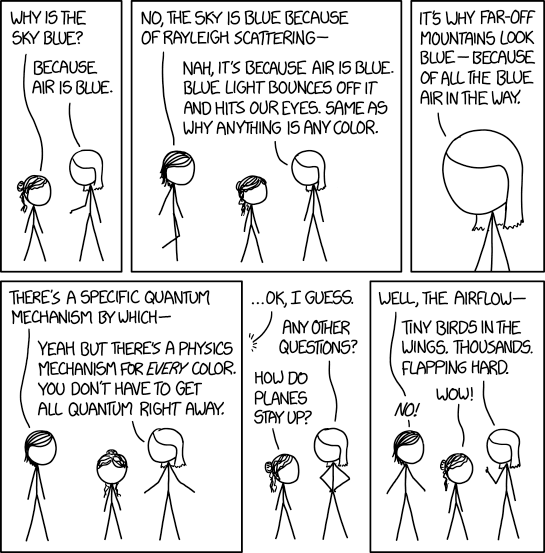
By sheer coincidence, xkcd recently did a comic on why the sky is blue at about the same time the astronomy class I TA got to its unit on light and optics.

Credit: xkcd
The Wednesday before that comic appeared, I led a discussion in which I explained why, in fact, the sky is blue. The comic argues against starting out with Rayleigh scattering because, essentially, that's just a fancy name for the specific reason the sky is blue, when the general reason is just that things are the color they are because they reflect that color.

I agree with this argument on one level, and one of the reasons I mentioned the sky's blueness in discussion is because it's an example of one of the three broad reasons why an object is a particular color (reflection/absorption, spectral lines, and thermal radiation). But I also mentioned the blue of the sky because Rayleigh scattering is interesting in a couple ways.

First of all, one way to think about the color of the sky is instead to think about the color of the sun. Sunlight is white (composed of all the colors in the visible spectrum), yet the sun is yellow. Why? Because Rayleigh scattering scatters some wavelengths (blue) more than others (red). The result is that wherever you look, you're looking at the sun; it just depends on whether or not the sun's photons had to bounce around a few times before they got to your eyes (and consequently look like they're coming from somewhere other than the sun).

The second reason I brought up Rayleigh scattering is that, for most objects that are a particular color by dint of reflection, the explanation for why is both complicated (a specific configuration of quantum mechanical energy levels) an unilluminating (it just worked out that way). By contrast, Rayleigh scattering is one of the few instances where the explanation is fairly simple and clear. We can see the process at work throughout the day. Shorter wavelengths of light scatter away as they pass through air. The more air they pass through, the more they scatter. This is why sunsets and sunrises are particularly red: the sunlight is moving through more atmosphere (because the sun is not just straight up), and the blue light has a lot of opportunities to get lost along the way.

But ultimately, xkcd is right that blue is just the color of air, as long as we want to think of color as a property of an object. And why wouldn't we? Well, we can engage in some fun-sucking reductionism by pointing out there is no blueness contained within air, just as there is no greenness contained within leaves. Color arises out of an object's interaction with light and eyes, and it just so happens that a particular interaction involving the sky produces blue. Many philosophers will want to push back against this kind of reductionism by saying, well, okay, then that's just what we mean by the property of blueness: being so configured that interaction with light and eyes produces the subjective experience of blue.

This is a common theme in analytic philosophy. Science has a tendency to unravel our everyday notions by telling us things like, no, we don't really ever touch an object; it's just the electric forces of our skin interacting with the electric forces of the couch. But philosophers balk at this by arguing that we clearly successfully communicate something when we say that, for example, humans have touched the surface of the moon. So let it be that what touching really means is... you get the idea.

But then what does it really mean to say that an object is blue, if blueness is a property that arises only through interaction? Well let's do a little thought experiment. Imagine that one of those TRAPPIST-1 worlds—tidally locked into its orbit around a cool red dwarf—has an atmosphere just like ours. On tidally locked worlds, the sun never rises or sets. One half of the planet is always facing the sun, while the other half never sees it. This could lead to a situation (although an atmosphere probably helps to mitigate it) where one half is a blasted hell hole and the other is a frozen wasteland. Consequently, many scientists and SF authors have imagined life arising only in a narrow strip of twilight at the terminator between night and day. There, the temperature might be just right for life. With a cool red sun (meaning much less blue light to start with) always on the horizon, a sky such as ours might always be some shade of red.

Credit: ESO
Nevertheless, scientific-minded aliens in the twilight might eventually learn the composition of the atmosphere, learn about Rayleigh scattering, and come up with a neat science fact: you know, if you were to shine an enormous amount of white light through our atmosphere, it would appear blue. But is that a good reason to say that the atmosphere is, in fact, blue?

Let's go a step further. Say that the general lack of short wavelength light means that these aliens' eyes never evolved sensitivity to blue light at all. Again, they could perform experiments and develop a theory of optics, but there's no situation in which they would describe the sky as blue, because they have no concept of blue at all.

However, blue-seeing humans are only 40 light years away, so we might someday travel there and explain the reality to them. We might say, your sky looks red, but that is only an illusion. If your eyes were sensitive to short wavelength light, and your planet were not tidally locked, and your star were luminous enough to shine brightly across the specific range of 400-700 nanometers, then you'd see that in reality your sky is, in fact, blue. The aliens would twirl their fuzzy tentacles in derision and laughter, as aliens are wont to do.

Now you might object here and say that we have plenty of names for things we don't have direct subjective experience of. For example, we've labeled the rest of the electromagnetic spectrum, from gamma rays on up to radio waves, even though we only have access to a tiny bit of that spectrum. And that's true enough, but we wouldn't say that the color of an object is x-ray. There might be some property there, but it's not color.

Okay, but let's turn the tables around here. Maybe TRAPPIST aliens are sensitive to infrared light and have a whole host of specific names for the wavelengths they subjectively experience in that range. That sounds a lot like color, too, and it seems anthropocentric of us to deny them their infrared colors. So we can say that blue is a human (or Earth creature) color and that an object is that color when it reflects light in a particular range of wavelengths. That's what color is: the subjective experience of a particular wavelength of light.

But then the aliens might ask, so what's the wavelength of this "brown" color you humans are always talking about? Brown does not have a wavelength; it doesn't show up in the rainbow. Brown is a color humans experience because our perception of color is based on more than just wavelength; it also includes contrast levels and overall brightness. Brown only shows up when something with a red or yellow wavelength is dim compared to what’s next to it.

Purple, too, is not a "real" color by the rough definition given above. It is not composed of a single wavelength but multiple wavelengths that our brains interpret as a single color. Why? Because we don't actually have perfect, exact wavelength detectors in our eyes. Instead, we have three different kinds of cones (photoreceptor cells) that absorb light in three ranges of wavelengths that overlap a bit.

Credit: Vanessaezekowitz at Wikipedia
Our brain figures out what color we're seeing not by identifying a particular wavelength but by adding up how much each type of cone has been stimulated. When a blue cone starts firing more than the rest, our brain will interpret that as seeing blue. But we don't have purple cones. Instead, the human brain has made up the color purple for those situations when our blue and red cones are firing at equal rates.

So what do we say when the aliens ask what it means for something to be purple? Oh, an object is purple when it reflects both short wavelength and long wavelength visible light in a situation where creatures evolved to pick out that combination as signifying something distinctive. Ah, yes, of course.

All of this is not to say that there's no such thing as color, or that trees aren't brown. Again, it does no one any good to object to every statement about the color of an object by saying, "Well actually, leaves absorb everything but green!" So yes, the sky is blue because air is blue. That is a perfectly fine answer that conveys an important aspect of what color is all about. But that important aspect might not be that color depends on reflection; rather, it might be that the idiosyncratic history of our sun, our planet, and our species have led to the subjective experience of color.

Sunday, February 7, 2016

Who Cares What Old, Dead White Guys Thought?

The title of this post is inaccurate if you don't consider the ancient Greeks to have been white. But that's probably not a discussion I want to get into right now. Anyway, today we're discussing my ancient philosophy course from last semester, or more precisely, my Socrates, Plato, and Aristotle course.

There are two main points I'd like to articulate: (1) if philosophy has made objective advancements in the last 2,400 years, why should we care what philosophers thought 2,400 years ago, and (b) man, I had a really annoying classmate in my ancient philosophy class. In essence, I'm wondering whether it was worth it to take this class, just as I had similar concerns about the value of paper writing in my philosophy in literature class from last spring.

To think about the first point, there are two paths you can go down. First, you can go the "philosophy is the mother of science" route and wonder where that leaves philosophy nowadays. That is, there used to be essentially no distinction between being a philosopher and a scientist. Science is a relatively new word, and people like Newton were referred to as "natural philosophers." Science was just doing philosophy about nature rather than philosophy about justice or god or what have you.

The usual argument you see here is that philosophy birthed the sciences we're familiar with today, and where it's done so, philosophy is obsolete and the science is all that's left. There are still philosophers of physics today (after all, I took a class on that, too), but they're not doing physics. Philosophers of physics no longer ask whether the world is made of four fundamental elements, or if all matter is composed of atoms, or if the planets travel in perfect circles, because physicists have definitively answered those questions (no, depends, no).

So the domain of philosophy has shrunk. Where philosophy about the natural world is still relevant, it's in asking questions about physical models, rather than coming up with the models themselves. (Metaphysicists might disagree, but a lot of modern philosophers don't hold metaphysics in particularly high regard, as I understand it.) Similar shrinkage has occurred in the other sciences, with psychology being one of the latest disciplines to squeeze philosophy further.

Here I want to look at a particularly egregious example from my ancient philosophy course, Plato's tripartite soul. Plato reasoned that a statement and its contradiction cannot both be true at the same time. This is reasonable and one of the foundations of classical logic. Take a statement like, "The sun is yellow." Either that statement is true, or the statement, "The sun is not yellow" is true. They can't both be true, because one implies a contradiction of the other.

So then let's look to the soul. We've all had the experience of simultaneously wanting and not wanting the same thing. "I want to eat that chocolate cake" and "I don't want to eat that chocolate cake" are thoughts we can have at the same time. In the first instance, it's our carnal desire for the cake, but in the second instance, it's our willpower that's talking. But if the law of non-contradiction holds, it can't possibly be true that we can both want and not want a piece of chocolate cake simultaneously.

...unless we have a divided soul, as alluded to above. Plato identifies three different competing interests in the human psyche that can produce contradictory desires. Roughly, these are the appetitive, passionate, and rational parts of the soul. They are distinct and incompatible, Plato argues, otherwise the law of non-contradiction is contradicted.

And that's all well and good, and proceeds from some reasonable assumptions, but it's baloney as far as modern neuroscience and psychology are concerned. What a hundred years of research into the brain have taught is that the brain is really complicated, possibly the most complicated three pounds in the universe, and it's decidedly not true that you can chop it up into distinct, one-pound chunks.

(I've cleverly switched from talking about the soul to talking about the brain, but a distinction between the two was not necessarily important to Plato, and science says that "the mind is what the brain does.")

There are two main ways in which Plato's tripartite soul fails as a theory. The first is that there are probably many components to the human psyche, far more than three. The second is a subtle problem that has plagued philosophers for thousands of years, which is that it's possible for words and concepts such as "want" to have different meanings depending on the context. So you can want something, and you can want* something. The former may mean "desire enough to actively pursue," whereas the latter might be "like thinking about but have no inclination to pursue." In that case, you can not want something, and also want* it, and there is no contradiction.

This is a tricky problem that crops up all over the place, which is why analytic philosophers spend large chunks of their time trying to tease apart just what we mean when we talk about seemingly plain concepts such as free will or beauty or truth.

But if all we have to go on is what remains of a large, sometimes disjointed collection of Plato's writings, it's easy to find flaws in his logic. His work cannot defend itself. It's also possible that those old, dead white guys were just wrong about stuff. They had a limited amount of data and lacked the thousands of years of philosophical tradition (that they began) to draw upon.

Which brings me to my annoying classmate. During lecture, he frequently raised his hand and asked the instructor questions such as, "But doesn't that produce a contradiction?" and "But wouldn't that mean nothing is beautiful?" and "But didn't Plato condone slavery?" And every single time, the instructor would engage with him and answer his questions in a thoughtful manner.

Terrible, right? Provoking the instructor into discussing philosophy with us. Well, yes. We had two lecture periods and one discussion period per week, and he brought up his objections during the lecture period. His interruptions were so frequent that there was material we were never able to cover in class. And all of this was possible because, yes, duh, Socrates and Plato and Aristotle were wrong about stuff. It was very frustrating, but I suspect I'm coming off as kind of petulant here, so let's go back to Plato for a moment.

While Plato did divide the mind into three different parts, he had particular affection for one of those parts: the rational mind. It was through employing the rational mind in dialectic that truth could be revealed. This is where Plato's allegory of the cave comes in. Plato conceived of a metaphor where the reality we perceive is just shadow puppets lit by torchlight that we are forced to watch in some kinky Clockwork Orange setup.

Philosophers, however, have broken out of the cave and can see real objects illuminated by the pervasive, powerful sun. So there's a distinction between the ever-changing, distorted, and 2-dimensional shadows we think of as reality and the constant, colorful, 3-dimensional objects that actually compose reality. When we see a chair, we are only seeing an indistinct, imperfect shadow of a chair that does not fully encompass the essence of true chairness.

At first blush, this whole idea seems patently ridiculous. We all accept that our eyes can deceive us and that reality is maybe actually electrons and protons, but it seems laughable to suggest that in some eternal, unchanging realm there exists the true forms of the objects we behold here. Where is this realm? Is there a form of the electric fan there, the cell phone, the credit card offer?

Well, it's unclear how diverse Plato intended his realm of forms to be, but he almost certainly thought it was populated by mathematical objects. Many ancient Greeks (including Plato) took math and geometry as the model of a priori knowledge, knowledge we could come to know just by thinking logically and without relying on evidence from our senses. To Plato, this meant accessing Platonic forms.

So there's some ideal triangle out there, as well as a perfectly straight, infinitesimally thin line, and also the true form of the number 5. Again, this sounds plainly absurd. But let's look at a particular number, such as the ratio between the circumference and diameter of a circle: π.

In a little over a month, it will be Pi Day, which means the internet will be stuffed with memes about π pies and whether ϕ is the true constant and how π is a magical number that contains everything in the universe.

That last one relies on a conjectured property of π, that it is a normal number. A normal number is one that has an endless sequence of digits in a non-repeating pattern that are distributed perfectly randomly, with no particular numeral being more likely than any other. Assuming that’s true, then if you peer deep enough into the digits of π, you will eventually find your telephone number, or a bitmap of your face, or your life story written out in ASCII code.

But you'll also find a lot of nonsense, and there's no way to tell the true from the false, so this is more like Borges' Library of Babel than, say, the Encyclopedia Galactica. It’s true that highly random data has a lot of information in it, but there’s nothing profound about that; that’s numerology, not number theory.

Additionally, it turns out that almost all (real term) the real numbers are normal, but it's not easy to pick out any particular number and say that it's normal. Currently, there is no proof that π is normal, although the evidence suggests that it is.

But what if there is no proof? What if it turns out to be impossible to demonstrate rigorously that π is a normal number? (You can often prove that it's impossible to prove something in math, but maybe a proof is just never found.) In math, a statement is only taken to be true if can be proven via deductive logic. So if there is no proof that π is normal, is it normal?

Well you're probably thinking, it's either normal or not, duh. Its being normal doesn't depend on whether or not we're smart enough to prove it. The Earth was four and a half billion years old long before we were able to show, scientifically, that it was. But look what's happened here. We've asserted that π has definite properties independent of our conception of it. That is, we're saying π is real, as real as the Earth, and that it has a form beyond our crude and incomplete perceptions.

So perhaps Plato's forms are not as crazy as they sound. Now, I'm not arguing that Plato is correct and that numbers are "real." This is a lively debate in the philosophy of mathematics (a subject I'll have more to say about at the end of this semester), with the other positions being "idealist" and "anti-realist." But Plato originated (or was the best, earliest articulator of) one tradition in this philosophical debate.

Which brings me back to my annoying classmate. If instead of a philosophy course, this had been a course on the history of Ancient Greece, at no point during the lecture would a classmate have interrupted the instructor with, "But teacher, weren't the Athenians wrong to butcher and enslave whole cities?" Of course they were wrong! That is clearly not up for debate. What's interesting, however, is why the Greeks did what they did, and how their actions propagated through history. That is, I want to understand the legacy they left behind, the traditions they began.

And that's how I look at an ancient philosophy course. To me, it's not primarily about finding all the myriad logical inconsistencies in the thoughts of some old, dead white guys, but in understanding how their thinking shaped humanity for millennia to come. In some cases, their ideas are obsolete and need to be discarded, while in others they represent the seeds of debates still flourishing in philosophy now. The greatest difference I see is that philosophers today strive for precision and nuance so as to avoid falling into the same old traps. But we couldn't have gotten here, couldn't have learned that lesson, without first falling in.

Tuesday, January 19, 2016

Quantifying Weirdness

Quantum mechanics is weird; there's no doubt about that. It’s got wave-particle duality, the uncertainty principle, and spooky action at a distance. Other fields have weird results, too, but although we might comment on the peculiarity of a particular finding, we do not indict other fields as a whole. With quantum mechanics in particular, though, it seems like its idiosyncrasies leave people with the feeling that it is either too weird to be right or too weird to be understood.

Well, today I'd like to help dispel those attitudes, particularly the first one—or at the very least put a number on just how weird quantum mechanics is. To do so, I'm going to be regurgitating material I learned in my philosophy of physics course.

In order to quantify the weirdness of quantum mechanics, we'll be exploring the phenomenon of quantum entanglement. Hopefully, we'll be able to unravel some of its mysteries and not get caught in a web of confusion.

I'm sorry, I promise there will be no more entanglement puns.

Entanglement first gained widespread awareness in physics after a 1935 paper by Einstein, Podolsky, and Rosen, henceforth known as the EPR paper. Einstein was unhappy with how that paper turned out, but he articulated his thoughts more clearly to his colleagues (especially Schrodinger) in private. Additionally, the thought experiment proposed then was more complicated than it had to be. The upshot is I'll be talking about this from a slightly more modern perspective; but historically, the EPR paper is one of the jumping off points for discussing quantum funny business.

So here's entanglement. In quantum mechanics, particles like electrons are described by a wave function which tells you the probability of finding the electron in a particular state. One such state is spin which, because of weird quantum mechanical reasons, can be either up or down. So the wave function could say there's a 50% chance the spin is up and a 50% chance it's down, for example.

You won't know what the spin is until you measure it. When you do so, the language is that the wave function “collapses,” so now it's just in one state, either up or down, instead of a superposition of both.

If two electrons are hanging out, normally you have two wave functions to keep track of. But if two electrons get created together in a particular process, then they will be described by a single wave function. Once that happens, barring interference from the outside world, it is not possible to decompose that wave function into two separate ones.

Where before your wave function for a single electron said there was a 50/50 chance of spin-up or spin-down, now it might say something like there is a 50% chance that electron A is spin-up and electron B is spin-down, and a 50% chance that electron A is spin-down and electron B is spin-up. So if electron A is in your lab, and electron B is down the road at the chemist, and you measure electron A to be spin-up, then you know the wave function has collapsed to "A up, B down." This means you also know, without having measured it, that electron B is now spin-down. If you do later measure it, you will always find it to be spin-down if A was up.

Here's where things get weird. Again, as long as you prevent your electrons from being interfered with, they remain entangled until you measure the spin of one of them, no matter how far apart the electrons get. So if electron A is in your lab, and you send electron B to Alpha Centauri, when you measure the spin of electron A, you instantly know, across a distance that would take light 4 years to travel, what the spin of electron B is.

This is weird.

Here's another scenario. This one is totally going to blow your mind. Imagine you are playing a game with a street magician. He's got two hands and one coin. While your back is turned, he puts the coin in one of his hands and then asks you to guess where the coin is. There's a 50/50 chance for either hand. You say left hand. He opens, and reveals that there is no coin there.

Now here's the wacky part. Assuming the magician exhibits no trickery and that the coin is in one of his hands, you now know, as if by magic, that the coin is in his right hand. Even if the magician performs some real magic and sends his right hand to Alpha Centauri after hiding the coin, you know instantly, across a distance that would take light 4 years to travel, that the coin is in his right hand. Information has traveled faster than light—a clear violation of Einstein's special relativity!

Okay, no matter how hard I try, I can't make that second scenario sound as weird as the first one. But why not? Because you're saying, “Silly Ori Vandewalle (if that even is your real name), nothing spooky is going on here. The coin's location is a result of the magician's actions before the hands are separated. Revealing the hand doesn't decide the fate of the coin. Duh.”

This is essentially the argument that Einstien made in the EPR paper. If two electrons are entangled, and one of them is sent to Alpha Centauri, and measuring the spin of one tells you the spin of the other, then the only reasonable conclusion you can draw is that the spins were determined beforehand.

The name of the EPR paper is, "Can Quantum-Mechanical Description of Physical Reality Be Considered Complete?" Following Betteridge's law, Einstein posited the answer was no. That's because quantum mechanics can only tell you the probability of the electron's spin being up. But just as with the magician's coin, Einstein argued, this probability represents nothing more than our ignorance, not any actual indeterminacy on the part of the coin or the electron.

So is the weirdness gone?

Well, let's see if we can't make this spooky action even more mundane. Another way to think of this result is that the two electrons are correlated. If two objects are correlated, they have a common cause. A caused B, or B caused A, or C caused both A and B. So we are suggesting that some common cause configured both spins beforehand but didn't bother to tell the wave function this.

In the 60s, physicist John Stewart Bell developed a theorem that must be true about any three binary properties of a single system. This theorem tells us something important about common causes. There are a few assumptions that go into the theorem, the most relevant of which is that, once you measure property A, that measurement can't affect properties B and C before you measure them.

Let's go through Bell's theorem with cookies so that I can distract you from the fact that we're doing math.

By Kimberly Vardeman from Lubbock, TX, USA (Perfect Chocolate Chip Cookies) [CC BY 2.0], via Wikimedia Commons
Say you've baked a batch of cookies, and the cookies can be large or not large (L, ~L), have walnuts or no walnuts (W, ~W), and have chocolate chips or no chocolate chips (C, ~C). Now say you want to know how many large, non-walnut cookies you have. We'll call that N(L, ~W). This number is the sum of all large, non-walnut, chocolate chip cookies N(L, ~W, C) and all large, non-walnut, non-chocolate chip cookies N(L, ~W, ~C). This must be true, because whether or not a cookie has chocolate chips does not affect its size or walnut content.

Similarly, the number of cookies with walnuts but no chocolate chips is N(L, W, ~C) + N(~L, W, ~C) because size doesn't matter. And finally, the number of large, non-chocolate chip cookies is N(L, W, ~C) + N(L, ~W, ~C) because walnuts don't matter.

Now let's add together the number of large, non-walnut cookies and the number of walnut cookies with no chocolate chips. That quantity is:

N(L, ~W, C) + N(L, ~W, ~C) + N(L, W, ~C) + N(~L, W, ~C)

If you notice, the second and third terms are also the terms for the number of large, non-chocolate chip cookies. That means our sum is always at least as great as the number of large, non-chocolate chip cookies.

Now let's make a slight shift and talk instead about probabilities. If you randomly reach out for a cookie, the probability that you get a particular one is directly proportional to the number of that cookie there is to take. This means we can reword Bell's cookie theorem thusly:

The probability of choosing a large, non-walnut cookie or a walnut, non-chocolate chip cookie is always greater than or equal to the probability of choosing a large, non-chocolate chip cookie.

This theorem is true regardless of how many of each cookie there actually is, because at no point in demonstrating this did we use numbers. It's also true no matter what kinds of properties we're talking about, so long as they are binary properties, because we could just as easily say L stands for lemon cookies or even something non-cookie-related.

But what's more, this theorem tells us about correlations. You see, if I give instructions to a thousand people to bake exactly the number of cookies I say and have each person randomly select and eat one cookie, we'll find that Bell's cookie theorem holds true. The probabilities will be maintained across all kitchens, because the cookie batches are correlated--spooky baking at a distance. The correlation is a result of the common cause known as me giving out instructions.

Now let's switch gears and talk about sunglasses—or as I prefer to call them, quantum shields. Polarized sunglasses only admit light that oscillates in a particular direction (up and down or left and right, for example). If you have horizontally polarized sunglasses, then only light waving from left to right (from the frame of the frames) will get through. But light coming from the sun is equally likely to be waving in any direction, so if you think about it, polarized sunglasses should only let a tiny, infinitesimal amount of light through—only light that is exactly horizontal and nothing at any other angle. Yet this isn't what happens. Polarized sunglasses will absorb roughly half the incident light and let the rest pass. Why is that?

Well, let's talk about the quanta of light, photons. A single photon doesn't have a direction it's waving, but it does have a polarization that is based on its spin. When a photon passes through sunglasses, the photon's spin is measured by the polarizing filter. Before the measurement, it's in a superposition of horizontal and vertical spin based on the angle of its spin (the direction it's waving).

When it's measured, that superposition collapses so that its spin is either horizontal or vertical. If it ends up being horizontal, it passes through. Otherwise, it's absorbed. The closer the angle of its spin is to horizontal, the higher the probability that it collapses to a horizontal spin. In this way, light from any polarization (except exactly vertical) can pass through, but the odds of it doing so go down the further away from horizontal you get, and anything that does pass through will subsequently be measured as horizontal. So sunglasses are quantum shields.

"Oakley half wire" by Jpogi at en.wikipedia.com. Licensed under Public Domain via Commons
This probability of getting a particular spin works for electrons, too, such as the two entangled ones in our EPR thought experiment. Instead of a polarizing filter, we use magnets to measure an electron’s spin. Before we talked about a 50/50 chance of an electron being up or down, but these odds can be adjusted by rotating our magnets in exactly the same way that light waves rotated away from horizontal have different odds of passing through sunglasses.

But this adds a new wrinkle to our thought experiment. Before, getting a spin-up on Earth meant the Alpha Centauri electron would be spin-down 100% of the time. If we rotate the Earth magnet by some angle θ, then that perfect correlation stops being 100%. It turns out that the odds of one being spin-up and the other spin-down are equal to cos2(θ/2), where θ is the angle between the two magnets.

We can carry out this experiment many times, creating entangled electrons and sending them to Alpha Centauri. A third of the time, we can measure with one magnet oriented at 0 degrees and the other at θ degrees clockwise, a third with one θ degrees and the other φ degrees, and a third with one 0 degrees and the other φ degrees. In this way, we are measuring three different binary properties of the system. Bell's theorem applies.

An entangled pair can be spin-up at 0 degrees and spin-down at θ degrees, spin-up at θ degrees and spin-down at φ degrees, or spin-up at 0 degrees and spin-down at φ degrees.

Bell's theorem tells us, then, that P(θ) + P(φ-θ) >= P(φ). Using the cosine formula up there, this comes out to cos2(θ/2) + cos2([φ- θ]/2) >= cos2(φ). Okay. Looks fine.

Except this isn't always true, depending on the angles you pick. Sometimes, the left-hand side will be less than the right-hand side. If you subtract the right from the left, then whenever Bell’s inequality is violated, the expression will be negative. You can see when that happens in this graph.

I am a Matlab Master.
So what does it mean for Bell’s inequality to be violated? Well, in the case of our cookies, the correlation was upheld because I sent out a common set of instructions to all the bakers. This is the common cause of the correlation. We saw that this common cause would lead to adherence to Bell's inequality for any set of three, binary properties of a system. This means that a common cause cannot be the origin of the correlation between entangled electrons. They aren’t deciding their configuration beforehand.

What Bell's theorem does permit is a non-local connection—the electrons instantly updating each other on their spin, or electrons that are governed by interactions across all of space. The other usual possible explanation for EPR and Bell is that electrons don't have any intrinsic reality, that realism itself is a foolish idea. No one likes either of these possibilities.

There are alternative ways of deriving, formulating, and generalizing Bell's theorem. When you do so via the CHSH inequality, you find that classical correlations can be no higher than 2. But quantum correlations violate this limit and can be as high as 2√2. And yet we can imagine other correlations, such as the Popescu-Rohrlich box, that are even higher than 2√2—correlations that you cannot reach even with entangled, non-local/non-real electrons.

So quantum mechanics is weird. But it's only weirder than regular spooky action at a distance by a factor of √2, or ~41%. Although √2 is irrational, so maybe quantum mechanics is unreasonably weird.

Friday, September 4, 2015

Here's Where the Fun Begins

Hey guys. Remember me? Yeah, I haven't done any writing (fiction, blogging, or otherwise) in quite a while due to life being somewhat chaotic of late. I'd like that to change, so here's a quick blog post just to make sure I haven't forgotten how to type.

So I'm almost done with my first week of class, and I have now been to (or watched) at least one lecture for all of my classes. In the order in which I did so, here's a brief summary of said lectures followed by some general commentary. Man, this sounds exciting. I wish it were possible for Statcounter to track the exact paragraph in which my readers decide to leave the page.

Monday morning I had Quantum Physics I, which is an introductory course in quantum mechanics. Intro QM courses often seek to get students to develop some intuition for the quantum realm, which is quite counter-intuitive compared to the well known land of blocks sliding across incline planes. To develop this intuition, professors have students solve the Schrodinger equation again and again and again until their dreams are nothing but operators and wavefunctions.

To that end, the textbook we're using is Griffiths, which is apparently the text almost all intro QM classes use. Page one of that book writes down the Schrodinger equation and simply plows ahead from there. My professor thinks this is actually kind of a dumb way to go about things, so we're beginning the semester with the story of how quantum mechanics came to be.

Now, having been a science dude for quite some time, this is a story I've heard a lot. I'm getting some math to go along with it this time, but in general the story of quantum mechanics goes something like this:

Near the end of the 19th century, the kingdom of physics was at peace. Two centuries earlier, the father of physics, the great Sir Isaac Newton, had discovered the Stone of Counting, Calculus (this is a really funny joke), and used it to tame the very moon itself. Later, Maxwell forged together electricity and magnetism to bring light to the world. And Boltzmann conquered heat with entropy. Plus maybe some other things happened in the intervening two centuries.

But then evil blackbody radiation from the quantum realm brought about the ultraviolet catastrophe. Using classical thermodynamics, physicists predicted that hot objects would emit an infinite amount of energy at low wavelengths. Oh no! But then Planck saved the day by creating oscillators that only emitted and absorbed radiation in discrete chunks. Forced to obey a Boltzmann distribution, these oscillators were too few in number at low wavelengths to bring about divergent infinities.

Yet this was a false peace. Where did these quantized oscillators come from, and why did they only act in multiples of Planck's constant? Tune in next time to find out. (That's as far as we got in lecture. The rest of the story involves the photoelectric effect, emission lines, and some other stuff, but this post is already 8 paragraphs long and I'm only on my first class. Maybe I'll write a children's book about quantum mechanics.)

Tuesday morning (I have another class on Monday, but it's a discussion section and didn't meet the first week) I had Philosophy of Physics. This class is taught by a Distinguished University Professor who got a PhD in Mathematical Physics several centuries ago but then decided to go into philosophy for some reason. It turns out this class is mostly going to be talking about the "weirdness of quantum mechanics," which should make it a nice complement to that other class where I'm just going to "shut up and calculate."

Weirdness, though, is not about how maybe we're all really connected and you can change the world just by looking at it and other quantum woo like that. To this professor, the weirdness of quantum mechanics arises from an SAT-like analogy. Relativity is to space-time as quantum mechanics is to information. That is, Einstein taught us that space and time aren't what our intuition leads us to think they are, and QM does the same for information. Information, which has roots in probability theory, works differently than we think it does and the consequence is that quantum stuff can be correlated in ways that classical stuff can't. I think this is going to be pretty interesting.

Both my quantum classes were prefaced with a quote from Feynman about how nobody understands quantum mechanics. My QM professor thinks this isn't really true anymore and that the results of QM speak for themselves, whereas my philosophy professor thinks we might be getting close to an understanding via thinking about information theory.

Right after that I had Ancient Philosophy. I'm taking this class mostly because I need a history of philosophy credit for my philosophy minor, but also because I want to learn about some of the lesser known ancient Greek philosophers (Pre-Socratics, Stoics, Epicureans, etc.). And the text is chock full of readings from/about those philosophers. It was a shame, then, to learn that the instructor will mostly be teaching us about the moral philosophies of Plato and Aristotle. Yeah, that's good stuff. But doesn't everyone know that Plato's utopia is a dictatorial city-state run by wise philosopher kings? Sigh.

After a morning of philosophy came Observational Astronomy, which is the next required course in the astro sequence. This course is less about what's out there in the universe and more about how we come to learn about what's out there. We'll be studying optics, image processing, celestial coordinates, statistics of signal and noise, and how CCDs work. The biggest chunk of this class grade-wise is some observational projects where we have to take data from the observatory and process it into something useful and meaningful. That's pretty awesome.

Wednesday morning was another lecture of QM. Wednesday afternoon I had Solar System Astronomy. Like ancient philosophy, I'm taking this course mainly because I need a number of upper level astronomy courses to fulfill my major. I'm not super-interested in solar system stuff, but for some reason I'm trying to graduate next spring (it might have something to do with me turning 30 in a couple months...), which means I kind of have to take what's available. Also like Ancient Philosophy, I learned during the first class that this won't be a wide-ranging course about all aspects of the solar system, but will focus mostly on planetary geology, delving into the planets and other rocky bodies that inhabit our sun's domain.

After some thought, I realized I'm actually pretty okay with this. The one novel for which I have something approaching a rough draft spends a lot of time on Ceres and Europa, two big spheres about which I am not all that qualified to say much, despite the number of Wikipedia articles I've read. So, you know, getting a grounding in how these kinds of worlds really work might improve my ability to write about the things I'm already writing about. Or it just might make my infodumps that much more painful. We'll see. Either way, this course involves a term paper about some topic in solar system astronomy, so I'll definitely be writing.

Thursday was identical to Tuesday, and I'm writing this Friday morning, but Friday is essentially identical to Wednesday. The only class I haven't talked about is an online one, Theory of Knowledge. This is an intro philosophy course in epistemology. The course probably technically started Monday, but due some technical glitches (the course is being hosted on the professor's personal website, which he coded himself), I wasn't able to watch the first video lecture until Thursday evening.

During that video, the professor talked about the benefits of online courses, such as the freedom to edit lectures into conveniently sized chunks by excising parts that aren't helpful. Also during that video, the professor gave instructions on how to access his site in a video that his students could only be watching if they had successfully accessed his site.

Anyway, I'm pretty excited about this course. Epistemology is a fascinating subject to me as it acts as a bridge between thinking about the world and knowing about it. The basic stance of modern epistemology is that knowledge is "justified true beliefs." But how do we know if a belief is true? And how can we justify our beliefs? And what does it actually mean to believe something? Epistemology asks and attempts to answer all these questions, and it does so in surprisingly technical ways, invoking psychology, neuroscience, Bayesian statistics, and other pretty modern tools.

Week 9 of the course examines the philosophy of psychedelic transformations. (But it's a 15 week course, so I'm okay with a brief excursion into eye-rolling territory.)

And that about does it. This is going to be my busiest, toughest semester since I returned to school for real in 2012. I've got 19 credits of 300 and 400 level classes. Plus I'm working.

As far as general commentary, I have two things to say. The first is a pattern that may be a coincidence or may be indicative of what happens at this level. My observational astronomy, quantum physics, and epistemology classes are all prereqs for more advanced topics. And all of those professors are covering a lot of ground that is necessarily going to be somewhat outside of their precise areas of expertise.

On the other hand, my ancient philosophy, philosophy of physics, and solar system astronomy courses mostly stand on their own and don't lead explicitly to anything else. And my instructors in those classes have chosen to focus on a particular branch of each field that happens to coincide with their research interests. Coincidence? Probably not. But it does mean I may want to pay more attention to which teachers are teaching which classes when I decide to take free-standing, upper level courses.

My other comment is that most of my instructors (this semester and previously) talk pretty openly about pedagogy, which I think is a good sign. One of the stereotypes of college is the ancient professor who stares at the blackboard with chalk in hand, talking nonstop for the duration of the lecture and paying little heed to any students who might also be occupying the classroom. My college career thus far has been largely absent that phenomenon, and I suspect the apparently institutionalized focus on pedagogy is partly responsible for that. So yay.

Thursday, May 14, 2015

Why Am I Writing This Paper?

I went another month without posting. Sorry about that. I have half a dozen things I'd like to write about, but instead I've been swamped with end of semester stuff--term papers, lab reports, studying, etc.

So instead, like I did before to keep your attention, here's one of my philosophy papers. I did not want to write this paper because it deals with a question that (a) I think the answer to is plainly true, (b) is depressing, and (c) brings to mind a lot of the terrible arguments I had with those close to me when I was super depressed.

Consequently, I procrastinated writing this paper and wasn't able to get started on it before I found a way to make it funny. But I did manage to conceive of a fairly novel (to me) argument while writing it, which is kind of the point, so that's good. Unfortunately, in the first draft (which I turned in), that novel argument was kind of muddled. I cleaned things up a bit for this post. So here's hoping my TA tries to find out whether or not I plagiarized anybody and ends up stumbling onto my second draft.

Before writing a paper, one should always figure out why one is writing it. However, to save time, I have decided to answer this question while writing it. More broadly put, the question I’m considering here is whether writing this paper is in some sense a meaningful thing to do. In asking this question, I will also be forced to wonder whether anything at all—up to and including being alive—is meaningful. A cursory examination of my thoughts reveals three potential reasons why I might want to write this paper: to get a good grade, to have some sort of positive impact on the world, and to give my life value. A detailed exploration will reveal that none of these are sufficient reasons for paper-writing and that it’s overwhelmingly unlikely that completing this assignment could be considered at all meaningful. And yet there is no possible way for me to reach this conclusion without analytically contemplating the question itself—without writing the paper. I could have come to a different conclusion, so it would appear that any necessary first step in finding meaning in life is looking for it.
The most compelling reason for writing this paper is that I want to get a good grade on it. When we ask whether something is meaningful in this sense, we’re inquiring as to the point or purpose of doing it. Here I am asking to what ends paper-writing is a means. While it may not always be easy to elucidate the motivation for any particular action, it seems clear that anything we end up doing was motivated by something. Thus the motivation for writing this paper—the meaning in doing so—is that I wish to excel academically. Within the context of academic excellence, it is easy to find meaning in paper-writing.
Where trouble arises is that the goal of getting good grades is itself embedded in broader contexts. So we might be tempted to ask why doing well in school is a meaningful activity. After all, if maintaining my GPA is not meaningful, it’s hard to argue that any task geared toward GPA maintenance is also meaningful in a deep sense. So we can follow a causal chain up from paper-writing that goes something like this: I’m writing this paper to get a good grade; I want good grades so that I can get a degree; I want a degree so that I can find a satisfying, well-paying job; I want a satisfying, well-paying job so that I can live a happy, moral life; I want a happy, moral life so that… well… here’s where our chain runs into some problems.
Why do I want to live a happy, moral life? It might be so that I can raise happy, moral children who will raise happy, moral children, and so on. There’s no escape from the chain in that direction. I might want to live this kind of life because I am motivated to do so psychologically. If I am merely a machine in a clockwork universe, then my desire to live such a life can be understood as a tool of biological evolution for producing viable offspring, like the kind of animal life described by Taylor in “The Meaning of Human Existence.” Happiness is meaningful only insofar as I am a more efficient tool when happy; morality is meaningful because social cohesion provides a better environment for rearing children.
We might be tempted to stop here and find meaning in being happiness-generating biological machines, but doing so forces us to admit other features of the natural world we find less palatable. We are also motivated to kill competitors, to steal mates, and to enslave our inferiors. In fact, any action we take can be rationalized as psychologically-motivated and thus ultimately stemming from biological urges. Not only does this seem to grant legitimacy to terrible actions, but it also doesn’t leave room for degrees of meaningfulness. If writing this paper is just as meaningful as binge-watching House of Cards (consuming popular media signals to others that I am a member of the group, increasing my social status and apparent reproductive fitness, or something), then there’s no positive reason to perform any particular action at all.
If we continue on down the causal chain, we must engage in some reductionism. Biology is nothing more than the chemistry of self-replicating, homeostatic, organic molecules. Chemistry is nothing more than the physics of very large chunks of atoms. And physics is nothing more than a fundamental description of reality. From this vantage, why we engage in any particular action such as paper-writing can be summed up rather neatly: because thermodynamics, or because the fine-structure constant is 0.0072973525698.
While these might be accurate descriptions of why we do what we do, they are not altogether satisfying as explanations. The reason is that there doesn’t appear to be any deeper significance to the laws of physics. It’s difficult to say that the purpose of writing a paper is to conserve angular momentum. In fact, such a statement hardly even seems intelligible, which casts doubt on it being meaningful. At the end of this causal chain, we’re left not with motivations for actions but abstract descriptions of them.
The way out that many take here is to suppose that the underlying rules do exist for a reason, and that reason is God. If there is a transcendent entity who makes all the rules, including the rules that govern what is meaningful or moral, then acting in accordance with the purpose laid out by this being would be a meaningful way to spend one’s life, as Wolf alludes to in “The Meanings of Lives.” In that case, all I have to do is figure out whether or not me writing this paper is part of God’s plan.
Ah, but which God? Throughout the span of human history, we have described (either via revelation or invention) a great many possible gods. It’s unlikely that I’m going to be able to settle on the correct one before completing this paper. In fact, it’s not even clear how one might go about proving that a particular god is the correct one, because many who profess such knowledge claim that it is a subjective matter of faith. I might be tempted to find one specifically devoted to paper-writing, but that seems somewhat self-serving.
In the absence of any definitive proof about which gods are real, I am forced to abandon my search for meaning down the path of purposes and points. While there is certainly meaning within limited contexts, there is not a clear way toward objective meaning by focusing on the reasons for acting a particular way.
Perhaps the meaning of a thing is not found in the reason for it but in the significance of it. Perhaps me writing this paper will have an impact on the world or be felt in some way. This sense of meaningfulness is divorced from notions of what is good about paper-writing and instead focuses on the lasting effects of paper-writing. Something is meaningful if its creation adds to the world, changes the course of things, or leaves a mark. Here, meaning is found in the positive features of a thing—its extent and shape.
From this perspective, it’s easy to see how my paper will be meaningful. It will have a significant impact on the way its grader spends a half hour. Rather than binge-watching House of Cards, the person deciding my grade will read my paper, mark it up, complain about its inanity to sympathetic ears, and be forced to wrestle with ELMS in order to record my grade for all time. There are two possible objections one might make to this conception of meaning: it’s rather permissive, and our intuitive sense of meaning is of something grander.
Meaning as impact is permissive in that significance is lacking qualification. Everything I do has an impact on the world. Every breath I take rearranges the positions of billions and billions of air molecules. Given the sheer number of states that can be occupied by the atoms around me, everything I do ensures a permanent change. That is, after I act, nothing will ever be exactly the way it was before. Every tap of the keyboard makes microscopic changes in the structure of the keys themselves. These are all lasting changes to the world brought about by my direct intervention, but few would describe any of it as meaningful. Yes, from this perspective, writing papers is meaningful, but so is scratching my head or yawning.
So then we must be discerning about what qualifies as significant if we wish to exclude the trivial. One possible criterion is that actions must be noticed for them to be significant and meaningful. Because I have no direct awareness of how my actions change the molecules around me, my breathing is not noticeable and thus not significant. This qualification still permits my paper to be meaningful because someone else will be forced to read it, which might okay. We can say that my paper would be more meaningful if it were read by more people, if its brilliant philosophical insights changed the way millions thought, if it were referenced in Wikipedia articles, if undergraduate students taking introductory philosophy courses a thousand years from now were required to read it. This sense of meaning gets at the grandeur lacking from simply capturing the attention of a grader for a short while.
We can object to this notion of meaning in two ways. First, meaning as a noticeable impact on the world is grounded concretely in the limitations of human awareness. These limitations can be overcome by advances in observational tools. For example, we could imagine a world in which robots with exquisite sensors monitor the microstates of air molecules in my house and broadcast that information across the internet for all to consume. Under such a scenario, my breathing has once again become meaningful. But in the opposite direction, that which too few of us are aware of is not meaningful. We can imagine another world in which the prosperity of our civilization rests on slave labor that is hidden from us. We would all find it to be very significant indeed if the weight of our world were carried on the backs of the impoverished, and it seems incongruous to believe that the meaningfulness of this notion depends on our being aware of it. It’s also reasonable to believe a hidden slave population should be meaningful to more than just the slaves, especially because it is easy to conceive of a world in which they are unaware of why they labor.
The second objection picks away at the seeming grandness of what we are capable of doing. Having my paper appear on the reading list of future generations is about as significant as paper-writing can get. We can move up in scope and ask what possible significance my life in general could have. History is certainly peppered with great men and women who have done awesome and terrible things that echo in the present. Many historians might quibble with the idea that great people are ultimately responsible for the changes we see, but it’s probably possible to have a lasting impact on human civilization.
Yet here we are faced with the inevitable absurdity of human life. History is doubtless populated by countless significant figures we remain forever unaware of. But beyond that, the extent of our possible significance is quite literally infinitesimal. Virtually every human event in history has taken place inside a sphere with a radius under 6,400 km. The distance to the nearest star is 6 billion times that; the distance to the nearby Andromeda galaxy is half a million times that; the known size of the universe is a hundred thousand times as large as that; and the universe in all its unknown extent may be infinite. Geological records indicate that most species don’t persist longer than a few million years. Even if we beat the odds, in five billion years the Sun will swallow the Earth. If we somehow manage to escape that, the heat death of the universe will eventually erase any contribution we make. And long after we are gone, the universe will continue to exist for a span that is possibly trillions of times longer than its current age.
In “The Absurd,” Nagel objects to this notion of absurdity by pointing out that if nothing we do now will matter in a million years, then it doesn’t matter now that nothing we do will matter in a million years. But this misses the importance of meaning as significance. What’s important about this conception of meaning is persistence, whether through time or space. Binge-watching television isn’t meaningless because it happens not to be important years from now, but because its effects don’t persist through those years. It captures my attention while I am engaged in it but has no effect beyond its limited scope. So if the condition for meaningfulness is persistent significance on a large scale, then everything we could do ultimately fails.
Finally, we are left with a definition of meaning that most closely resembles more traditional meanings of the word meaning. It is possible that writing a philosophy paper could give my life value. That is, writing this paper may be an expression of who I am, a tool that others could use to gain knowledge about me. This is what it means for something to have meaning. The dictionary definition of a word tells you what a word is about; similarly, this paper may tell you what I am about and consequently be meaningful. In this sense, something is meaningful if it builds up some representation of an object that lets us understand something about that object.
From this notion alone, we can again naively conclude that paper-writing is clearly a meaningful activity. Anyone who reads this paper will gain some measure of insight into how my mind works. Similarly, anything I end up doing with my life can be meaningful if the events of my life create a narrative which tells you about me. Yet that presents us with a problem, because our intuition tells us that some lives might be more meaningful than others and that this should depend on what you end up doing with your life. It shouldn’t depend on the quality of the representation that can be built up based on your life.
As an example of why not all representations we can construct about a thing are meaningful, consider lightning. We could image a picture of lightning as being a manifestation of Zeus’ anger over the fact that we build skyscrapers. You could even argue that Zeus has reason to be mad at trees and sometimes even people. This is a description of lightning which may match what we observe, but we would not say that it is a meaningful description of lightning. It does not correspond to what we now know lightning to really be about—electricity, ions, and the like. So what we might say is that some things you do with your life—such as going to the bathroom or watching television—might not be meaningful because they don’t correspond to what we really know life is about.
Once again we are confronted with our sense of what is meaningful. That is, if we sense that some life activity is meaningful, our belief is that the activity accurately maps on to the person. If we follow the sense analogy, we can consider two ways in which we can sense what is out there in the world. On the one hand, our eyes see in color. It might seem obvious to believe that color inheres in objects, but the mechanism by which eyes work suggests something else. Rather, our eyes detect the intensity of light around three wavelength bands and then construct colors based on that information and a variety of other contextual clues. Color is not something that really exists but something our minds make a posteriori because it is useful for distinguishing between objects.
On the other hand, we also sometimes see objects that resemble triangles. Triangles, rather than being something we experience, are things we can construct a priori based on the formal rules of geometry. When we see a triangle in the world, we are comparing it to the Platonic triangle that is a product of our reason.
The parallel with our sense of meaning is this: is meaning a useful tool we build up from experiences, or is it an abstract entity that we see reflected in the world? If I write a philosophy paper and others see something meaningful in it, does that meaning arise from a psychologically-motivated heuristic about what’s important in life, or from a formal system that deductively defines human experience? If it is the former, then that meaning may not necessarily connect to what’s out there in the world—namely me. If the latter, then perhaps my paper is a true reflection of me and the sense of meaningfulness accurately signals this.
Unfortunately, there are no problem-free theories about what humans really are. Are we invested with souls? Are we rational agents or just animals possessing the illusion of control? What is the essence of being a human? What is consciousness? Does personal identity persist over time? Many of the questions regarding what it means to be human come down to what Nagel calls the subjective character of experience, a problem some consider unsolvable. We can never really know what is going on inside another person’s head because qualia are simply not objective. This leads us to the conclusion that it is very unlikely our haphazardly constructed brains have stumbled upon a sense of meaningfulness that is logically sound, so our sense is not a reliable indicator of whether what someone does with their life reflects who they really are. This does not rule out the possibility that people can do meaningful things, but it does rule out our knowing about it. And it might not make sense to say that something can be meaningful if no one gets the meaning, in which case nothing is meaningful.
From all this I can conclude that there is no point to writing this paper, that doing so will have no lasting impact on the world, and that it does not say anything meaningful about who I am. I clearly shouldn’t have wasted any time on it. However, it cannot be ignored that I could not have reached this conclusion without carefully considering what it means to be meaningful. While the arguments I present show that life does not appear to be meaningful, they do not prove that life could not be meaningful. This leaves open the possibility that we may discover some meaning in the future, and the only path toward that meaning is through thinking about it. So writing papers about meaning is not meaningful, but it might be a prerequisite for meaning.

Friday, March 13, 2015

On Dumbledorean Realism

I wrote a paper this week for my literature in philosophy course discussing the dream argument. Because it's been a little while since my last post, I think I'll reproduce the paper here (with a few changes) just for the heck of it. I procrastinated, though, which means I wasn't quite able to make my point as well as I had intended.

The gist of my argument is that there is no way to define a concept of a "real world" that resembles the world we inhabit (and are comfortable calling the real world) while simultaneously excluding the possibility of "unreal worlds." This leaves us with two possible conclusions: (1) if we do actually inhabit an "unreal" world, then unreal worlds are what reality actually is; or (2) we inhabit an unreal world and real worlds are nothing at all like the type of world we live in.

When talking about the world we seem to live in, I lean toward option 1 because I think it allows us to do some work ontologically. That is to say, I think we can feel justified in calling real many things that might not seem to be real depending on your point of view (subatomic particles, ideas, time, etc.). When talking about my truly fundamental beliefs, however, I subscribe to a system that you might say is a combination of options 1 and 2. But that's a whole 'nother bag of beans (worms? shrimp? cats?--a quick googling doesn't settle this). Anyway, without further ado, here's my damn essay. Oh, also, spoiler alert for the final Harry Potter. But come on, I haven't even read the book and I know what happens.

Near the end of the final book in J. K. Rowling’s Harry Potter series, Harry Potter and the Deathly Hallows, Harry has a seemingly impossible conversation with his mentor Albus Dumbledore. The seeming impossibility of this conversation is predicated on both characters apparently being dead at the time. As the conversation draws to a close and Harry realizes that he might not actually be dead, he asks Dumbledore, “Is this real? Or has this been happening inside my head?” The ever clever Dumbledore answers, “Of course it is happening inside your head, Harry, but why on earth should that mean that it is not real?”
This brief exchange alludes to a problem that philosophers have wrestled with at least since Descartes and to a plot device employed in many works of fiction, from Borges’ short story The Circular Ruins on through to contemporary films such as The Matrix and Inception. The problem is this: what is the difference between the real world and one only inside our head, or one that is illusory or fictitious? To get to the heart of the matter, the question is often posed thusly: how do you know that you are not dreaming or being dreamt? If we could answer this question succinctly, then we would have a clear conception of what the real world is and whether or not we are in it.
I think it might be useful, however, to tackle this question from the opposite direction. So the question might instead be posed: how do you know that you are dreaming? That is to say, if we assume that you are dreaming, what could happen in the dream world that would allow you to correctly conclude that you are, in fact, dreaming? There is an easy but unsatisfactory answer that immediately comes to mind—you could wake up. Unfortunately, all this tells you is that you were dreaming; it gives you no information about what’s happening to you in the moment.
In fact, waking up doesn’t even tell you that you’re not dreaming, because it is not entirely uncommon to have a “dream within a dream” à la Inception. That phrase may be something of a misnomer, though, for what it describes seems no different than moving from one dream to another, an experience with which many of us are also familiar. It is more accurate to say, then, that dreaming can be followed by the apparent experience of waking up, regardless of whether or not we actually do wake up.
Rather than focusing on waking up, it might be useful to examine elements of dreams that strike us as particularly dream-like. But if we’re dispensing with waking up, we can generalize dreaming to include other types of unreal experiences, such as being simulated, fictional, dreamt, or imagined. The common thread that binds these experiences is an apparent disconnect between our subjective awareness and what the real world truly is. It may seem something of a leap to lump in these other concepts, however, because all of us have had the subjective experience of dreaming but few of us would claim to have ever been a fictional character. In comparing these disparate types of unreality, then, we must consider not what it feels like to be that way but what elements are common to our conception of unreal worlds.
I posit that there are four features we might say are characteristic of various forms of unreality. These are abrupt changes, rule violations, missing information, and absurd scenarios. To get an idea of what I mean by these terms, a few examples might be necessary.
We’ve already seen examples of abrupt changes just a few paragraphs up. If you move from one dream to another, then the steady flow of reality has been altered, continuity broken. You may have been dreaming of playing in the World Series and then suddenly shifted to a dream of your wedding day. More generally, abrupt changes abound in our unreal creations. In chapter 6 the main character may decide to take a trip across the country, and in chapter 7 the main character may arrive without the intervening journey having been written by the author.
Rule violations would seem to be the most obvious feature of unreality. Natural laws apparently govern what we are comfortable calling the real world, so an unreal world should not feel bound to obey said laws. Stories taking place in a fantasy or science fiction setting are often rife with events that could not happen according to the laws as we know them. Dreams very often involve impossible happenings, such as reunions with long-dead relations or the ability to fly by flapping your arms. The only limit to what may happen in an unreal world is our imagination, and I can imagine a being possessing a far greater imagination than I have.
Our next unreal attribute is a little harder to pin down. Missing information is the fact that unreal worlds are often insufficiently detailed. An author may write a mundane, temporally continuous story where nothing out of the ordinary happens, but it is very unlikely that the author will describe, unless motivated to do so by story concerns, how that character’s internal organs function, or what’s happening on the other side of the world. This might not seem troubling; after all, I am not constantly aware of everything happening inside my body. But if a fictional character can have a subjective experience produced by the work of fiction that character inhabits, does that character have internal organs not written about? Worse still, if a fictional character is in a room described as merely “plain” or “having four walls,” how rich are the perceptions of that character regarding the room? This is missing information.
Finally, unreal worlds are very often absurd. What constitutes absurdity can certainly be a matter of opinion, especially because I am distinguishing this from scenarios that explicitly contravene physical laws. So for our purposes, absurd scenarios are ones that are prohibited by no natural laws but that we are confident would never happen in reality due to their implausibility. I may dream that I am trapped in an elevator playing Monopoly with all of my ex-girlfriends; this is a deeply unlikely scenario, but no law ever conceived of by Newton says it cannot happen. Absurdist fiction follows similar lines. Look to any TV sitcom such as Seinfeld for examples of situations that may not be physically impossible, but certainly aren’t likely.
With the features of unreality defined, are we now equipped to correctly conclude, if we’re dreaming, that we are? Unfortunately, we are not. If these four elements are common to unreality, then I can identify three possible scenarios we associate with the real world that could explain these elements.
The first is this: in what we are comfortable calling the real world, our scope is limited. Humans are finite, non-omniscient beings. We gather up our experiences of the world through our senses and derive much more, but not everything, from our capacity to reason and imagine. I mentioned earlier that the impossibility of unreal worlds can be thought of as a product of our seemingly unlimited imagination. And it may be true that our imagination is infinite. But even if it is, infinity is not everything. For example, it can be shown that there is an infinite quantity of rational numbers between 0 and 1 (1/2, 1/3, 1/4 … 1/10,327,452, etc.), and yet none of those numbers is the number 2 (or any other number greater than 1, of which there are an infinite number). So even granting an unlimited imagination, a human’s experience of the world is not all of the world.
Thus we are very often apt to encounter events we have failed to anticipate, events which may seem to violate the laws of the universe or be absurd. Consider the first Native Americans to witness European colonists sailing in giant wooden ships, riding horses, and firing guns. No experience had by a Native American up to that point could have prepared them for such an encounter, and yet it happened and was real. Or consider what it might have been like if an asteroid comparable to the one that killed the dinosaurs had struck the Earth during the course of human history but before the advent of telescopes. The world would have changed abruptly, and the change brought about would have been absurd and seemingly in violation of the natural laws taken for granted. The real world is certainly not a place that can suddenly be engulfed in flames, tidal waves, and blackened skies, we would have thought. But we would have been wrong.
From this we can see that our expectation of what is absurd or impossible is a consequence of the limited scope through which we view the world. It is highly dependent on what we have experienced or imagined so far.
The second scenario in which the defining qualities of the unreal world become insufficient is one in which our senses deceive us. All of us are aware that we can be fooled by optical illusions or that we can hallucinate. We think of such instances as being exceptional, but increasingly research in neuroscience points to our being fooled as the norm. This fact can account for  abrupt changes and missing information, to say nothing of hallucinations in which absurd or impossible events occur. A real example of an abrupt change in the world is that which occurs during a bout of dreamless sleep. It is night outside, and then suddenly it is light and eight hours have passed. We excuse the continuity break only because it happens every day. A further illustration is highway hypnosis, in which we can be in one place at one time and then another place at another time with no conscious awareness of what occurred in between.
Missing information manifests in our shoddy attention to the world around us. Cognitive scientists have great fun demonstrating our inattentional blindness by having us watch videos in which we can miss wardrobe changes, people swapping, or gorillas. All of this demonstrates that we can completely fail to be aware of the real world out there and yet have no sense that we do not inhabit a richly detailed world.
This conception, however, is predicated on there being a real world which we can somehow know despite what our senses tell us. Much of this view arises out of modern science, which has allowed us to build up a representation of the world that is free of illusions and hallucinations but also only marginally connected to what we observe empirically. So while we may see color and shape and contrast, what we know from physics tells us that light is just a wavelength of electromagnetic radiation governed by Maxwell’s equations.
But this modern notion is ultimately borne out of experiments performed and reason applied to the observed results of those experiments. In other words, observation has taught us that observation is flawed. But our observations of the real world and our observations about our observations are flawed in the same way: we do not connect directly to the world but build up an image that is filtered through our senses and constructed by our brain. More abstractly, there is a real world, and there is our experience of that world; they are not the same thing. Here it would be wise to remember Morpheus from The Matrix, who tells Neo, “If you're talking about what you can feel, what you can smell, what you can taste and see, then 'real' is simply electrical signals interpreted by your brain.”
Finally, all manner of unreal occurrences can be accounted for if we live in a world governed by supernatural entities. This is the famous evil demon present in Descartes’ Meditations. But it is also a world governed by any kind of god whatsoever. If we live in a world in which miracles can occur, then we live in a world in which the laws of physics can be flouted, abrupt changes can occur, and absurd events can transpire. Rather than evidence of being dreaming or fictitious, miracles would be evidence in favor of a particular supernatural entity.
Moreover, if something exists that is supernatural, the implication is that two kinds of world exist: the natural and the supernatural. Superficially, miracles connote a world that very much seems to resemble an unreal world. If we are dreaming, dreamt, fictitious, imagined, or simulated, then there is some person or entity which is responsible for and has created the unreal world of which we are a part. We could call such an entity a god.
Some might object here by arguing that this is not what fictional universes are generally like. If an author writes a fantasy novel, there may be gods in that novel, but the author is not usually one of them. And yet it is not inconceivable that such a story could be written. It would be no trouble at all for me to write a story about characters in a world created by the god Ori Vandewalle, who sets forth such and such laws and demands such and such prayers. In a slightly less vain direction, science fiction author Greg Egan has written a trilogy of books, beginning with The Clockwork Rocket, that takes place in an alternate universe with laws of physics different from our own. If we are positing the reality of fictional characters, he has a created a new universe subordinate to and different from our own.
So then we have failed to identify criteria sufficient for determining that we are dreaming. But this failure is not a result of dreaming being too slippery a phenomenon to get a handle of; rather, the conclusion is that the type of awareness that comes from existing in an unreal world is indiscernible from the type of awareness that comes from existing in a real world. That is to say, there is no difference between real and unreal. An “unreal world” is one in which a creator in the “real world” imposes an incomplete, incongruent, potentially impossible image on the inhabitants of the unreal world, an image which may not be empirically similar to the real world. Our real world, on the other hand, is one in which we construct an image of the world from the information that falls into us, and the image we form may be incomplete, incongruent, potentially impossible, and ultimately controlled by a supernatural entity.
We cannot know if we are awake because there is no difference between being awake and dreaming. Or rather, if we are forever dreaming, or being dreamt, or fictional or simulated or imagined, then that’s what it is to be real. We might call this Dumbledorean Realism. Yes, it may all be in our heads, but that doesn’t mean it isn’t real. To say otherwise, to say that being a fictional character is not what it is to be real, is to say that a true real world is one in which unreal elements cannot impose themselves—a world that could not have been made by a creator, where subjective experiences map directly onto the world perfectly, and where all inhabitants are omniscient and could only fail to anticipate that which could not happen anyway.